
Online school is now a real, full-time education option for K-12 students, not a backup plan. But the data shows results depend heavily on program quality. This post breaks down the real numbers, a real case study, and what parents should check before they enroll a student.
The Growing Debate
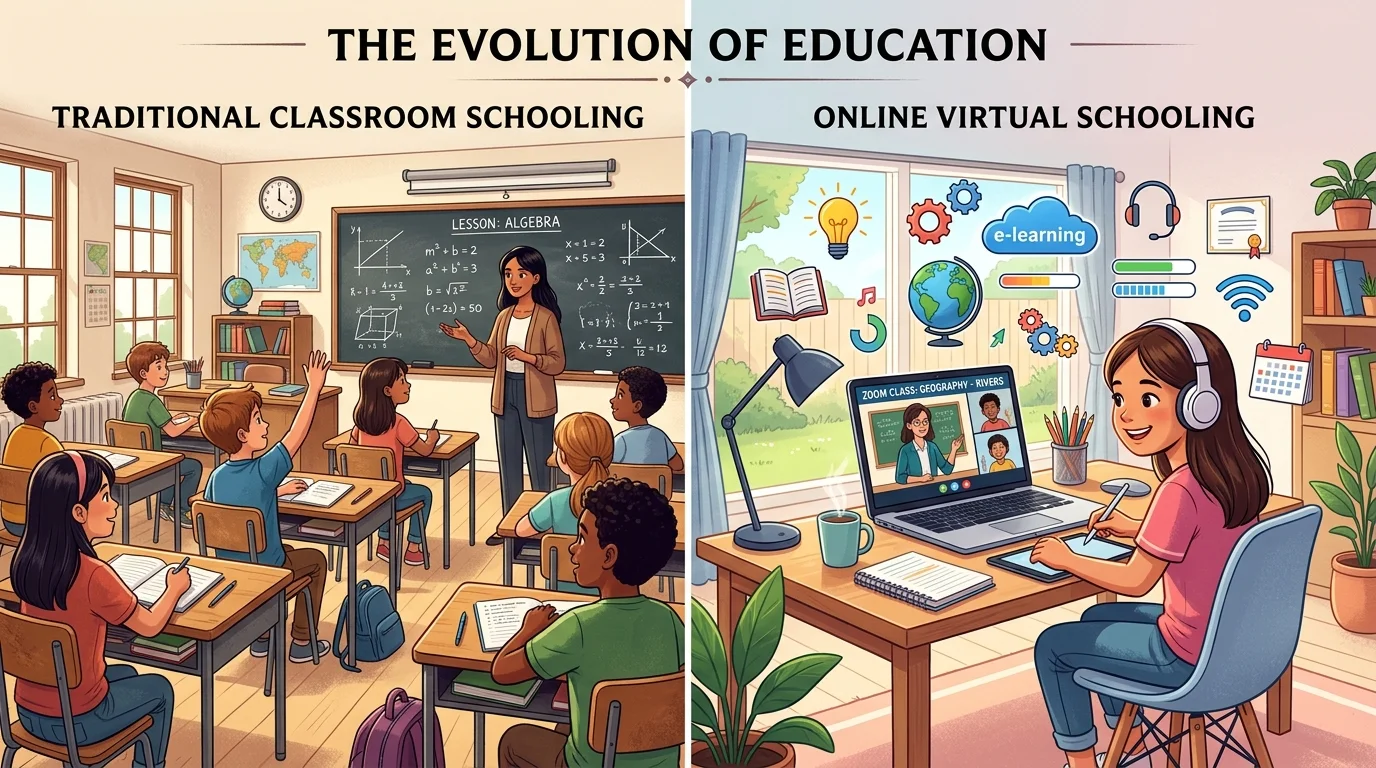
Parents, teachers, and policymakers are asking: Does online school really work as well as traditional school? The pandemic forced millions into online classrooms, but now families want to know whether this shift should continue.
Every year, more families ask the same question. Should my child go to a traditional school, or should I try an online school program instead?
It is not a small decision. You are picking how your child learns for years. And right now, there is more noise than clear answers.
Some blogs say online school is the future. Some parents say their kid fell behind in a virtual program and never caught up. Some say traditional school is too rigid. Others say it is the only safe choice.
Here is the honest problem: both sides are partly right. Online school and traditional school are not one thing each. They are both umbrella terms. A K-12 online school with live teachers and a Cambridge curriculum is not the same as a free, unstaffed course library. A packed public high school with 40 kids per class is not the same as a small private school.
So when someone says “online school works” or “online school doesn’t work,” ask: which online school? Which program? Which student?
That is the real question this post answers, using data, not opinions.
What Happens When You Pick the Wrong Program
Let’s look at a real case study first, because this is where things get serious.
Stanford University runs a research group called CREDO, the Center for Research on Education Outcomes. In one of the largest studies ever done on this topic, CREDO compared students in full-time online charter schools to closely matched students in traditional public schools, across 17 states plus Washington, D.C.
The result was rough. Students in the virtual charter schools learned the equivalent of 72 fewer days of reading and 180 fewer days of math per year, compared to their matched peers in traditional schools, according to the CREDO Stanford Online Charter School Study. That math number is close to an entire school year lost.
This is not a small gap. This is the kind of gap that follows a student for years. And it happened at scale, across a large group of virtual charter schools, not one bad school.
Why did this happen? A few reasons keep showing up in follow-up commentary on the study:
- Many of these programs were self-paced, with little live teacher contact.
- Some students had weak internet access or no quiet place to study.
- There was little structure to keep kids on task day to day.
- Support systems that a normal classroom gives for free, like a teacher noticing a struggling student right away, were missing.
This is the part families skip when they hear “online school.” They picture a laptop and a curriculum, and assume the learning happens on its own. It does not. A program without live teaching, structure, and accountability can quietly cost a student a full year of progress. That is the real risk.
There is a cost side too. Confusion around online schools has led to real dropout and disengagement problems. Some virtual programs report higher dropout rates than traditional colleges and schools, and low self-discipline is named as a top reason, according to Legacy Online School’s K-12 and higher education data report. So the risk is not just academic. It is a student losing motivation and quitting halfway.
If you are a parent reading this, this part should make you pause. Not because online school is bad. Because a bad online school is bad. And it is easy to end up in one if you are not checking the right things.
Is online school actually better than traditional school?
The answer from the data is more complicated than many websites suggest.

Online schooling can solve real problems. A student may need a flexible schedule because of sports, travel, work, family responsibilities, or health needs. A student may also want a course that their local school does not offer.
At the same time, online learning can create new problems. Students have to manage their time. Parents may need to provide more support. Students can miss the structure and daily social contact of a physical school.
The important point is that “online” is not one type of education.
A live online high school with daily teacher interaction is very different from a self-paced program where a student works alone for most of the day. A well-supported K-12 online school is also different from emergency remote teaching during the COVID-19 pandemic.
The data becomes much clearer when these differences are taken into account.
The numbers show that online learning is no longer a small option
Online education is now a normal part of the K-12 education system.
According to NCES, 2.5% of U.S. students ages 5 to 17 were enrolled in full-time virtual education during the 2022–23 school year. The same report found that 7% of enrolled or homeschooled students took at least one virtual course, while 3% took all of their courses virtually.
That does not mean most students are leaving traditional schools. Most students still learn in traditional school settings. But the numbers show that online learning is now part of the wider K-12 education system.
There is another useful number. According to NCES, 21.0% of public schools offered at least one course entirely online during the 2017–18 school year. Among traditional public schools, the figure was 20.2%.
High schools were much more likely to offer online courses. According to NCES, 58.9% of high schools offered at least one course entirely online in 2017–18. The figure was 12.7% for middle schools and 2.7% for primary schools.
So the real comparison is no longer “technology versus school.”
It is one school model versus another.
The biggest advantage of Online School: flexibility

Flexibility is one of the strongest reasons families choose online schooling for K-12.
A traditional school normally follows a fixed timetable. Students arrive at a set time, attend classes during scheduled periods, and follow the school’s academic calendar.
Online school programs can offer more control over when and where learning happens.
That can be useful for a student who needs to train during school hours, travels frequently, lives far from a particular program, or needs to repeat a course.
This is especially useful in high school.
A student might use an online high school course to take an advanced subject that is not available locally. Another student may use an online course to recover a credit. Someone else may simply prefer learning at home.
The data from Florida provides a useful example.
Florida Virtual School: A Case Study
Florida Virtual School, often known as FLVS, is one of the best-known examples of a large public online school system in the United States.
According to the Florida Virtual School 2023–24 Legislative Report, FLVS served 235,897 students during the 2023–24 school year and recorded 725,659 semester completions
Those numbers include students taking individual courses as well as students enrolled full time.
The model also shows why the phrase “online school” can be misleading.
FLVS does not simply put students in front of recorded videos and leave them alone. According to Florida Virtual School, students interact with teachers and peers through live learning sessions and collaborative assignments. Students can also take part in clubs, events, activities, and virtual field trips.
The program also offers more than 200 courses, including Advanced Placement, honors, world languages, college preparation, and career and technical education courses.
This is an important lesson for parents.
When comparing the best online school options, do not ask only whether classes are online. Ask how the program teaches, how teachers communicate with students, how progress is monitored, and what happens when a student falls behind.
Traditional school has one major advantage: structure

A traditional school provides structure without asking the student to create all of it.
There is a classroom. There is a teacher. There are classmates. There is a daily timetable. There are reminders, deadlines, activities, and face-to-face interactions.
For some students, that structure is extremely valuable.
A student who struggles with time management may find a self-paced online course difficult. A student who needs frequent reminders may fall behind if the program gives too much freedom.
The GAO found a similar concern.
According to GAO, virtual charter schools largely depend on self-paced and asynchronous instruction and often rely on parents to act as instructors. GAO reported that school officials said some students struggle with the level of independence required, while parents may find the time commitment overwhelming
That is a major issue that families should consider before choosing an online school.
Flexibility is helpful only when the student can use it well.
What the Better Data Shows

Now here is the other half of the picture, and it is a real one too.
Well-run online school programs are producing strong results. In fact, most of the negative headlines about online school come from a specific type of program: free, low-structure, self-paced virtual charter schools with little live teaching. Structured programs with certified teachers look very different in the data.
A 2025 report on K-12 online school statistics found that structured programs, with certified teachers and personalized learning plans, deliver outcomes equal to or better than traditional education, especially when they use recognized curricula like Cambridge, according to K12 Online Schools’ 2025 statistics report.
Student sentiment backs this up too. 70% of students say online learning gives them real advantages over a traditional classroom, mainly flexibility and the ability to learn at their own pace. And 81% of students say online learning tools had a positive effect on their grades, according to Coursmos’ Online Learning Statistics report.
Retention is another point worth a second look. The same report notes that learners in online settings retained between 25% and 60% of material, compared to 8% to 10% in some in-person settings, according to Coursmos’ Online Learning Statistics report. Numbers like this depend a lot on the course and the student, but the pattern is consistent across multiple studies: interactive online material, watched and reviewed at a student’s own pace, tends to stick better than a single lecture heard once.
Enrollment numbers also tell a story. During the 2019-2020 school year, 691 K-12 schools in the U.S. were fully virtual, serving nearly 293,717 students nationwide, and by 2020, 77% of public schools had shifted to some form of online instruction, according to a ConsumerAffairs report on online high school statistics. That is not a fringe experiment. That is a large, ongoing shift in how K-12 education actually works.
Growth is not slowing down either. Virtual school enrollment in states like Tennessee grew from around 10,000 students to over 17,000 in just two years, and Michigan alone now has more than 150,000 students taking some form of online course, according to Legacy Online School’s K-12 data report.
So what is the actual difference between a program that costs a student a year of learning and a program that helps a student thrive? It comes down to a short list of things you can check before you enroll.
What to Check Before Choosing an Online School Program

Use this as a simple checklist when you compare online school programs for your child, whether they are in elementary, middle, or high school:
Live teaching, not just recorded lessons:
A course library with pre-recorded videos and no live teacher is closer to the low-performing virtual charter model in the CREDO study. Look for a program with live classes and a real teacher your child can ask questions to.
A real, recognized curriculum:
Check if the school follows an established course of study, such as Cambridge, IGCSE, or a well-known national curriculum. This matters more than most parents realize. A recognized curriculum means the content is tested, staged correctly by grade, and accepted for further study, including at the high school and college level.
Small class sizes:
A student who never gets a moment with the teacher will not get much benefit from being “online,” and the same problem applies in a crowded traditional classroom. Small groups let the teacher actually notice when a student is falling behind.
A clear daily structure:
The best online school programs run on a set schedule, with set class times, set homework, and regular check-ins. This is what fixes the “self-discipline” problem that shows up again and again in dropout data.
Parent communication:
Ask how often the school updates parents on grades and attendance. A program that only tells you at the end of the term is too late to fix a problem.
Support beyond academics
Good programs also build in guidance, values education, and student wellbeing, not just test scores. This matters for younger students especially.
If a program checks these boxes, it is far more likely to land in the “works well” data rather than the “lost a year” data.
Online School vs Traditional School: A Fair Comparison

Neither option is automatically better. Here is the honest, short version:
Traditional school gives your child daily face-to-face contact with peers and teachers, a fixed schedule, and often lower cost if it is a free public school. It also comes with fixed pacing, larger class sizes in many areas, and less flexibility if your family travels or relocates.
Online school gives your child flexibility, a personalized pace, and access to strong programs regardless of where you live. It also removes daily commute time, which many families count as a real win. But it only works well when the program is structured and the teaching is live, as the CREDO data shows clearly.
For families living abroad, families that move often, or families that simply want a stronger academic program than what is available locally, a well-run K-12 online school can be one of the best options on the table. For families that value in-person social routine above all else, a traditional school, public or private, may still make more sense.
Here is the comparison laid out side by side:
| Factor | Online School | Traditional School |
| Schedule | Flexible, often fits around family routine | Fixed hours, set daily timetable |
| Pace | Can be personalized to the student | Fixed pace, set by the class |
| Class size | Often small, especially in structured programs | Varies widely, can be large in public schools |
| Location | Learn from anywhere with internet access | Must live near the school |
| Cost | Ranges from free public options to paid private programs | Often free if public, otherwise tuition-based |
| Social contact | Limited to virtual interaction unless program adds group activities | Daily in-person contact with peers |
| Commute | None | Daily travel time required |
| Curriculum options | Can access curricula not available locally, such as Cambridge or IGCSE | Limited to what local schools offer |
| Risk if poorly run | Can fall behind significantly, per the CREDO Stanford study | Can also underperform, especially in under-resourced schools |
| Best fit for | Families abroad, frequent movers, students needing a personalized pace | Families prioritizing daily in-person routine and local community |
Final Thoughts
The debate over online school vs traditional school is not really about which one is better. It is about which specific program is better for your child.
The data is clear on one thing: a weak online program, with no live teacher and no structure, can cost a student close to a full year of learning. That is the finding from a large, credible study, and it should not be ignored.
But the data is just as clear on the other side. Structured online school programs, with certified teachers, a real curriculum, and daily accountability, are producing strong results, high student satisfaction, and better grades for a growing number of families around the world.
So before you pick a path for your child, do not ask “online or traditional.” Ask “is this specific program built to actually teach, or just built to exist.” That one question will tell you more than any general debate ever will.
If you are comparing online school programs right now, you can look at how Nisar Academy structures its classes, curriculum, and fees as one reference point for what a well-built program should offer.
Check out our website to explore our online schooling programs, or browse our blog for more guides on online education