
Online schools Cambridge and Oxford standards is the question every parent types into Google before they trust a screen with their child’s future. The short answer: schools that follow the Cambridge Pathway use the same syllabus, the same exams, and the same grading rules as the top schools in the UK. This post breaks down the real data behind that claim, so you can check it yourself.
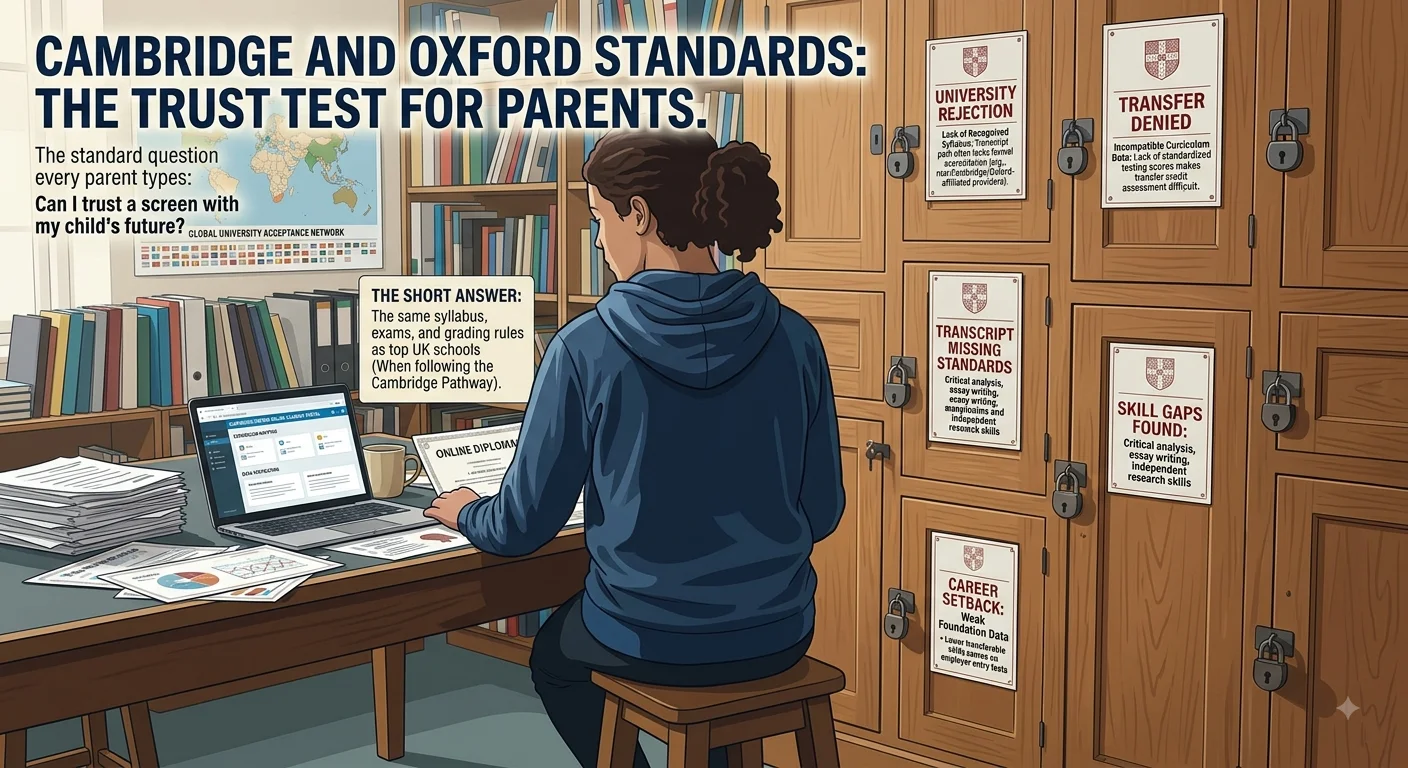
The Trust Gap in Online Education
You want the best for your child. You have heard the words “Cambridge education” and “Oxford standard” used in school ads for years. But now your child is sitting in front of a laptop, not a classroom, and you are asking a fair question: is this real?
Parents searching for an online school face a wall of doubt. Will this school follow a real curriculum, or a copy-paste version? Will the certificate mean anything when my child applies to a university? Will teachers know what they are doing, or is this just a video call with a textbook?

This trust gap is not imaginary. A 2022 survey by ISC Research found that 41% of parents questioned whether online schools could deliver the same academic quality as established brick-and-mortar schools. Employers also expressed uncertainty about online qualifications, especially when they weren’t clearly tied to recognized frameworks.
This doubt is not silly. It is smart. A school is one of the biggest decisions a parent makes. And “online” still sounds, to many people, like something less than a real school with a real building, a real playground, and a real bell that rings between classes
What Happens When Standards Are Missing
Here is where it gets serious. If an online school skips proper standards, the damage does not show up right away. It shows up years later, when it is much harder to fix.
University rejection:
Picture this. Your child studies for years online. Then it is time to apply to university. The admissions officer looks at the transcript and does not recognize the qualification. No exam board name. No international ranking. No proof of learning outcomes. The years of work do not open the door they were supposed to open.
Skill gaps:
Without rigorous standards, students may miss critical thinking, research, and analytical skills emphasized in Cambridge and Oxford curricula.
Or picture a smaller version of the same problem. Your child moves from Pakistan to Canada, or from the UAE back home. The new school asks, “What curriculum were you following?” If the answer is vague, your child gets placed in the wrong grade, repeats a year, or has to sit placement tests that catch them off guard.
Career setbacks:
Employers increasingly value transferable skills. Weak academic foundations can limit opportunities.
This is the real cost of choosing an online school without checking its standards. It is not just wasted school fees. It is wasted years. Confusion between Oxford and Cambridge branding makes this worse, many schools use both names loosely in marketing, without being formally linked to either one. Parents deserve to know the difference between a school that borrows a name and a school that actually follows a recognized pathway.
Consider the case of Minerva Virtual Academy, an online school launched in the UK in 2020. In its first year, parents worried whether its students would be accepted into top universities. The school responded by aligning its curriculum with Cambridge International Examinations. Within two years, graduates successfully entered Russell Group universities, proving that adherence to Cambridge standards directly impacts student futures.
This example highlights the urgency: online schools that fail to follow Cambridge and Oxford standards risk undermining their students’ long-term success.
The good news is that this problem has a clear, checkable solution. You do not have to guess. You can look at exact data.
How Online Schools Follow Cambridge and Oxford Standards

Curriculum Alignment:
First, a quick fact that clears up a lot of confusion. When people compare Oxford vs Cambridge for schools, they are often comparing two different things.
Cambridge International Curriculum: Online schools adopt syllabi designed by Cambridge Assessment International Education. These syllabi emphasize subject mastery, critical thinking, and global perspectives.
Cambridge Assessment International Education, known as Cambridge International, is the part of the University of Cambridge that builds school curriculum, sets exams, and issues certificates for students aged 5 to 19. This is the body that online schools plug into when they say they follow “Cambridge standards.” It covers four stages: Cambridge Primary, Cambridge Lower Secondary, Cambridge IGCSE, and Cambridge International AS & A Levels, based on the Cambridge Pathway model used across international schools.
Oxford AQA Collaboration: Some schools use Oxford AQA exam boards, ensuring assessments mirror the rigor of Oxford University Press standards.
Oxford’s role in school-level education mostly comes through Oxford University Press, which publishes many of the textbooks and reading books used in Cambridge classrooms worldwide, and through the reputation Oxford holds as a university destination for top students. So when a school says it follows “Oxford and Cambridge standards,” it usually means this: Cambridge sets the syllabus and the exam, Oxford’s books and academic culture shape the teaching style, and both universities sit at the top of the list when students apply after finishing school.
This distinction matters. A school that is honest about it earns more trust than one that blurs the line.
Teacher Qualifications:
Cambridge-certified teachers: Many online schools require teachers to hold Cambridge teaching certifications.
Oxford training modules: Teachers often undergo Oxford University Press training to ensure consistency in pedagogy.
Case Study Data: King’s InterHigh reported in 2021 that 85% of its teaching staff held postgraduate qualifications, with many trained in Cambridge pedagogy. This mirrors the teacher quality standards found in leading UK schools. See here kingsinterhigh.
Assessment Standards:
External examinations: Students sit for Cambridge IGCSEs or Oxford AQA exams, identical to those taken in physical schools.
Moderation processes: Scripts are marked externally, ensuring fairness and consistency.
Case Study Data: In 2022, Minerva Virtual Academy reported that its first cohort achieved a 92% pass rate in Cambridge IGCSE exams, comparable to UK national averages. This demonstrates that online delivery does not compromise exam outcomes when standards are followed.
Learning Resources:
Oxford University Press materials: Online schools often license textbooks and digital resources directly from Oxford.
Cambridge-endorsed resources: These include past papers, mark schemes, and study guides.
Case Study Data: Cambridge Assessment confirmed in 2023 that digital resource partnerships expanded to online schools, ensuring students access the same materials as traditional learners.
Student Support Systems
Pastoral care: Online schools replicate Cambridge and Oxford’s emphasis on holistic education by offering counseling and mentorship.
University guidance: Advisors help students apply to universities worldwide, using Cambridge and Oxford recognition as leverage.
Case Study Data: King’s InterHigh reported that 70% of its graduates progressed to university, including institutions like UCL and Warwick, thanks to Cambridge and Oxford-aligned qualifications.
The Cambridge Pathway, From Primary to University:
A school does not become “Cambridge standard” by adding a logo to its website. It has to run a full pathway.
Cambridge Primary covers ages 5 to 11 and builds the base in English, maths, and science. Cambridge Lower Secondary continues this from ages 11 to 14. Cambridge IGCSE, taken around age 16, is the qualification most people picture when they think of a Cambridge school. According to Cambridge International, the IGCSE stage is offered in over 150 countries and more than 5,000 schools worldwide, which makes it one of the most portable school qualifications in the world. After that comes Cambridge International AS & A Level, the pre-university stage that most Oxford and Cambridge University applicants complete before they apply.
This is not a small operation. According to PR Newswire’s coverage of Cambridge International’s own results release, close to 705,000 students in 148 countries received Cambridge exam results in the June 2026 series, with total entries reaching 1.7 million and AS & A Level entries up 5% on the year before. An online school that follows this same pathway is not inventing its own version of “Cambridge style” learning. It is entering its students for the same exams as students in London, Lahore, or Dubai, marked by the same board, on the same scale.
Recognition That Actually Travels:
The reason parents care about Cambridge in the first place is recognition. A qualification only matters if the next school or university accepts it.
According to a breakdown of Cambridge International facts published by Boston World School, Cambridge qualifications are formally recognized by more than 2,200 universities across 90 countries, including every university in the UK and many in the US. That is the number that should matter to you as a parent, more than any slogan. It means a transcript from a school following this curriculum, whether online or in a physical building, is a document that a university admissions officer already understands.

This recognition is also growing beyond private and international schools. According to reporting in Relocate Magazine on Cambridge’s growth in the US and Pakistan, Cambridge public schools and state school districts in the US are now adopting Cambridge qualifications alongside international schools, and growth is also strong in countries like China and Pakistan as more families look for internationally recognized options.
Distance Learning Made This Possible, Not Difficult:
Ten years ago, following a strict international curriculum from home was hard. Today it is normal. According to online learning statistics compiled by Coursmos, the K-12 online learning market is growing at roughly 12.5% a year, and online learning overall has grown by around 900% globally since the year 2000. This growth is not happening because standards dropped. It is happening because the tools to deliver a full curriculum at a distance finally caught up with the demand for it.
A good online school today runs on the same building blocks as a good physical school. Teachers follow the same Cambridge syllabus documents and past papers. Students read from the same approved book lists, often published by Oxford University Press or Cambridge University Press. Exams are still sat under exam board rules, whether at an approved exam center or through remote arrangements set by Cambridge International. Distance changes where the child sits. It does not have to change what the child learns.
English, Grades, and the Books Behind Them:
One more piece parents ask about: language and subject depth. Cambridge Primary and IGCSE both put heavy weight on English, since it is the language used across most of the Cambridge system and most Oxford and Cambridge University courses. According to Boston World School’s data, Cambridge IGCSE alone sees over 800,000 subject entries a year, and English-language subjects are consistently among the most taken. A school that claims Cambridge standards should be able to show you which set books, past papers, and grading rubrics it uses for English and every core subject. If it cannot show you this, it is not really following the standard, no matter what its marketing says.
A Real Case Study: What Following the Standard Actually Produces
Numbers about exam entries are useful, but results tell the real story. Look at the British International School of Ljubljana, a school that runs the full Cambridge curriculum. According to the school’s own published 2024 IGCSE results, 84% of its students achieved A* to C grades at Cambridge IGCSE, compared with a 71% UK national average for the same grade band the year before. The school also reported a 100% pass rate in IGCSE French and a 91% pass rate in Science subjects.
This is what “following Cambridge standards” is supposed to deliver: results that can be checked against a public, external benchmark, not a school’s own private grading scale. A school, online or physical, that genuinely follows the Cambridge syllabus can be measured the exact same way, because its students sit the exact same external exam as everyone else in the Cambridge system.
An Online School Built Around This Pathway

Nisar Academy is one example of this model in practice. It runs entirely online, teaching students from Playgroup through O Level using the Cambridge and Oxford curriculum framework alongside IGCSE, combined with Islamic Education and Tarbiyah. Families in Pakistan, Canada, Europe, and the UAE follow the same stage-by-stage structure described above, from early years through IGCSE, without needing a physical campus in any of those countries. This is what a genuine Cambridge and Oxford standard online school looks like once you strip away the marketing language: a clear pathway, a real curriculum, and a way to check both.
What This Means for You as a Parent
Here is the simple checklist that comes out of all this data. A real Cambridge and Oxford standard online school should be able to tell you exactly which Cambridge stage your child is in Primary, Lower Secondary, IGCSE, or AS & A Level. It should be able to name its exam center or its arrangement with Cambridge International for sitting exams. It should use set books from known publishers, not homemade worksheets pretending to be a syllabus. And it should be able to show you real results, the way the British International School of Ljubljana published its own IGCSE numbers, not vague claims about “excellence.”

None of this requires a physical campus. It requires a school that treats the online format as a delivery method, not a shortcut. When you find one that does this, the distance between your home and Cambridge, England, or Oxford, England, stops mattering. What matters is that your child is sitting the same exam, reading the same books, and meeting the same standard as students anywhere else in the world.
Closing the Trust Gap
The rise of online schools is not a compromise, it’s an evolution. By embedding Cambridge and Oxford standards, these schools prove that quality education can transcend physical classrooms.
The case studies of King’s InterHigh and Minerva Virtual Academy show that when online schools align with Cambridge and Oxford frameworks, students achieve outcomes equal to or better than traditional schooling.
For parents and students, the message is clear: online schools Cambridge Oxford standards are not just buzzwords, they are the foundation of credible, future-ready education.