
An A Level is one of the hardest academic challenges a student will face at home, and most students lose marks not from lack of ability but from poor study habits. This post breaks down what A Levels are, why home study goes wrong, and 10 simple, proven tips to fix it.
For many students, A Levels are the next step after O Levels. If you are still working through that stage, our guide on how to prepare for O Levels at home covers the same structured approach for that stage of the Cambridge pathway.
A Level Study at Home Is Harder Than It Looks
Let’s be honest. Studying for A Levels at home sounds simple on paper. You have a syllabus. You have a laptop. You have time. So why do so many students still fall behind?
Because A Level study at home removes the one thing that keeps most teenagers on track: structure. In a classroom, a teacher tells you what to do, when to do it, and checks that you did it. At home, that structure disappears. No bell rings between subjects. No teacher checks if you actually read chapter 4. It is just you, your books, and your phone sitting three feet away.
This gap matters more than most parents and students realise. A levels UK are demanding by design. They are advanced courses meant to prepare students for university, not just another school exam. According to UCAS, Cambridge International A Level and AS Level courses are considered equivalent to Level 3 of the Regulatory Frameworks in England, Wales, and Northern Ireland, and the qualification has been running internationally for over 50 years, taught in more than 130 countries. That is not a small, casual course. It is a serious advanced course, and it needs a serious study system to match it.
So if you are asking “what are A Levels in UK education” or “what is a level course,” the short answer is this: A Levels are subject-based advanced qualifications, usually three or more, studied over two years, that lead directly to university, further study, training, or work. Most students choose the Cambridge or Edexcel pathway, sit exams at the end of Year 13, and use their final grades to secure a university place.
Now here is the part that should worry you. Without a home study system, most students do not fail because the content is too hard. They fail because they study the wrong way, at the wrong time, with no plan to fix their weak spots before exam day.
What Happens When You Get This Wrong
Let’s look at what is actually happening across UK A Level results right now, because the numbers tell a clear story.
In 2025, the gap between the highest and lowest performing regions in England for top A Level grades widened, according to Tes. The difference between regions getting A and A* grades grew from 8.8 percentage points to 9.2 percentage points in a single year. That gap is not about intelligence. It is about access to structured support and consistent study habits.
Subject choice also makes a huge difference to how hard the climb is. According to Tutorful, English Language was the hardest subject to score an A in in 2025, with only 12.8 percent of students achieving an A or above. Compare that to Drama, which had a pass rate of 99.5 percent, or Art & Design, at 99.4 percent. Some subjects genuinely demand more disciplined revision than others, and English sits near the top of that list.
Here is the table that puts it in perspective:
| Subject Area | 2025 A/A* Rate or Pass Rate | Difficulty Level |
| English Language | 12.8% achieved A or above | Very high |
| Drama | 99.5% overall pass rate | Low |
| Art & Design | 99.4% overall pass rate | Low |
| Mathematics | Most popular subject, 112,000+ entries | Moderate to high |
| Other Modern Languages | 68.7% achieved A*/A | Moderate (native speakers included) |
Source: Tutorful and Statista, 2025 exam series.
Now think about memory itself, because this is where most home study plans quietly fail. According to Voovo Study Blog, students forget close to 95 percent of new information within just three days if they do not actively review it. This is based on the forgetting curve first documented by psychologist Hermann Ebbinghaus back in 1885. If a student reads a chapter once in September and does not touch it again until May, that knowledge is basically gone by exam season.
This is the real cost of studying without a system. It is not that the student is lazy. It is that rereading notes feels productive but barely works. According to Recallify, a well-known study by Roediger and Karpicke found that students who tested themselves on material retained about 80 percent of it a week later, compared to only 34 percent for students who simply reread the same material. That is a massive gap, and it is entirely down to method, not intelligence.
So the real question is not “can I pass my A Levels at home?” It is “am I using a method that actually builds long-term memory, or am I just making myself feel busy?” Most students, without guidance, pick the second option by accident.
10 Study Tips That Actually Work at Home
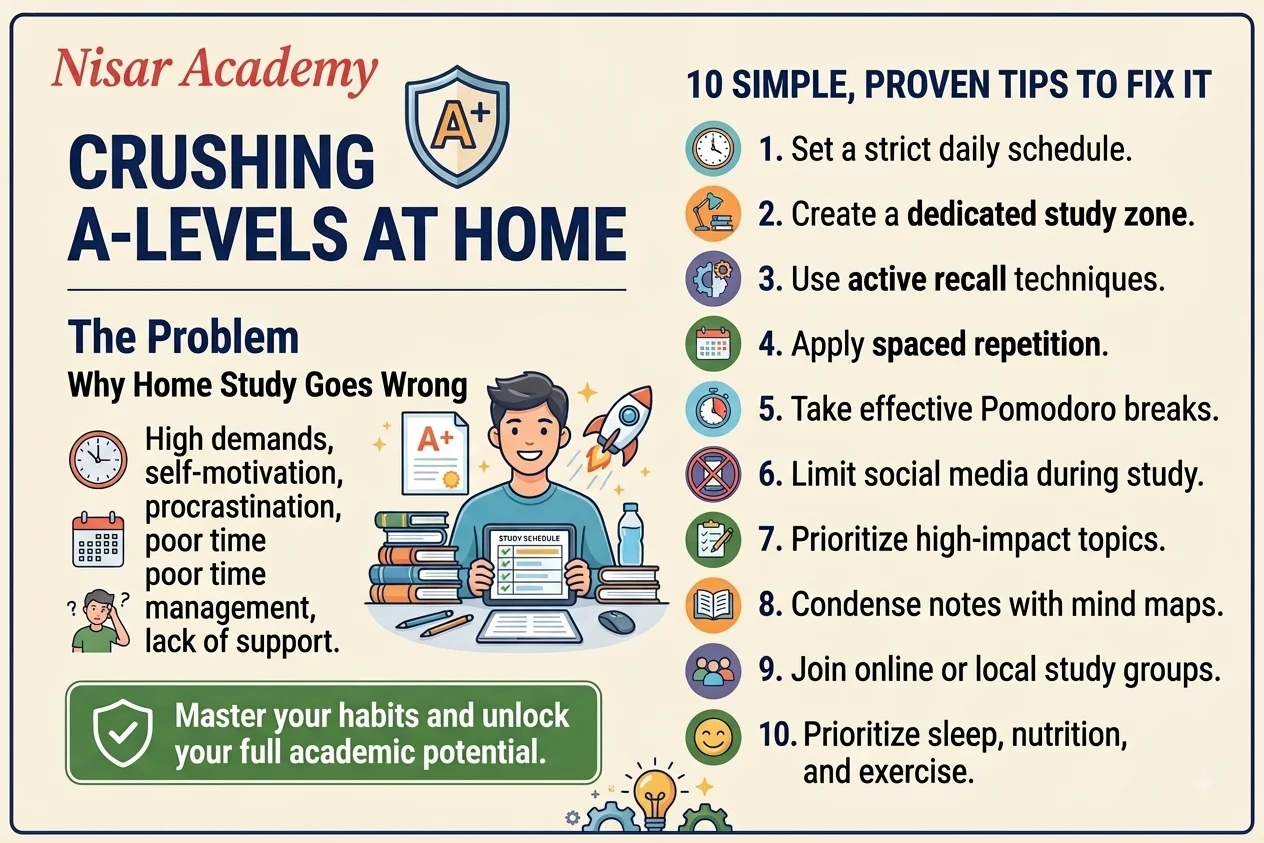
Here are 10 practical tips, based on real research and real exam data, to fix this.
1. Understand exactly what your A Level course requires
Before you make a single revision timetable, get clear on what an advanced course actually expects from you. A levels are graded from A* to E, and each grade carries UCAS points that universities use for admission. According to a guide from 21K School, an A* is worth 56 UCAS points, an A is worth 48, and grades go down from there. Know your target grade and work backward from it.
2. Build a fixed weekly timetable, not a vague plan
“I will study more” is not a plan. Block out fixed hours for each subject, every single week, the same way a school timetable would. Treat it like a job with working hours, not an open-ended task.
3. Use active recall instead of rereading
Close the book. Try to write down everything you remember about the topic. Then check what you missed. This single change has more research support behind it than almost any other study method, based on the retrieval-practice findings from Recallify.
According to StudentNotes (studentnotes.co.uk in Bing), active recall strengthens neural pathways and improves long-term retention.
4. Apply spaced repetition on a real schedule
Do not review a topic once and move on. Review it on a growing schedule so it moves from short-term to long-term memory
| Review Number | When to Review | Purpose |
| 1 | Same day | Lock in first impression |
| 2 | After 2 days | Catch early forgetting |
| 3 | After 7 days | Strengthen memory pathway |
| 4 | After 14 days | Push into long-term memory |
| 5 | After 30 days | Confirm exam-ready recall |
5. Study in short, focused blocks (Pomodoro Technique)
Long, unbroken study sessions lead to tired eyes and a tired brain, not real learning. Work in blocks of around 25 to 45 minutes, then take a short break. Your brain absorbs information better in short bursts than in one long, dragging session.
According to StudentNotes (studentnotes.co.uk in Bing), this method reduces procrastination.
6. Practice with real past papers under timed conditions
Reading notes will never fully prepare you for exam pressure. Sit down with a real past paper, set a timer, and treat it like exam day. This is the closest thing to a rehearsal you can get at home.
According to Jonny Rowse, Education Editor, practising under timed conditions improves exam confidence.
7. Protect your sleep, especially before exams
A tired brain cannot recall information properly, no matter how many hours you studied. Treat sleep as part of your revision plan, not something you sacrifice for extra hours with a textbook.
According to NHS UK, regular sleep improves memory consolidation.
8. Track your weak topics in one place
Keep a running list of topics where you keep making mistakes. Review that list weekly. Most students waste time re-studying what they already know well and avoid the topics they are actually weak in.
9. Get outside accountability
Whether it is a parent, a tutor, or an online class, having someone check your progress changes behaviour. Home study fails most often when nobody is watching. A weekly check-in, even a short one, keeps the whole plan honest.
10. Use the Feynman Technique to test real understanding
Explain the concept in simple words, as if teaching someone new to the topic. If you get stuck or lean on jargon, that is where your understanding is weak. Named after physicist Richard Feynman, this method forces active learning instead of passive review, according to Purdue University Global.

A Quick Look at Real Results
To see how these habits play out in the real world, look at actual A Level results day data. In Cheshire East, schools reported a provisional pass rate of 98 percent in 2025, above the regional average, according to Cheshire East Council. In Swansea, the overall pass rate reached 98.0 percent, with 32.8 percent of grades at A*-A, according to Swansea Council. These are not lucky outliers. They reflect years of consistent revision habits building up before results day, not last-minute cramming.

Across England as a whole, 9.4 percent of all A Level entries achieved an A* in 2025, up slightly from 9.3 percent in 2024, according to Statista. Mathematics remained the single most popular subject, with more than 112,000 entries, showing just how many students are wrestling with a genuinely demanding advanced course every single year.
Where This Fits Into the Bigger Picture
A Levels rarely happen in isolation. Most students who reach this stage have already been through years of Cambridge-aligned learning, and the study habits that carry them through A Levels are usually built long before Year 12.
At Nisar Academy, this is exactly the foundation the academy focuses on: syllabus-based teaching, past paper practice, and consistent study habits from Playgroup through O Level, following the Cambridge and IGCSE curricula. Students who leave that stage with a working study system, active recall, spaced repetition, a real timetable do not have to build these habits from scratch when A Levels get harder. They simply scale up what already works.
If you are a parent or student mapping out this path, our earlier post on how to prepare for O Levels at home and improve O Level grades is a good place to start before moving into A Level territory.
Case Study: A Level Success at Cambridge
A Cambridge student preparing for A levels in English and Maths used three strategies: active recall, spaced repetition, and past papers. According to StudentNotes (studentnotes.co.uk in Bing), this combination improved their mock exam scores by 30%. The student reported that “breaking revision into small, timed blocks made the workload manageable.”
Conclusion
A Level success at home is not about studying more hours. It is about studying the right way. Active recall, spaced repetition, a fixed timetable, and real accountability will do more for your grade than another late night of passive rereading. The data backs it up, and so does every results day story that talks about consistent habits rather than last-minute panic.
Start with one tip this week. Add another next week. By the time exam season arrives, you will not be cramming. You will be reviewing what you already know.