
Mid-year enrollment feels risky to most parents, but it is more common than you think. Every year, thousands of families move a child from a traditional classroom to online learning without waiting for a new academic year. This guide walks you through why families make this move, what it costs to wait, and the exact steps to enroll mid-year without stress.
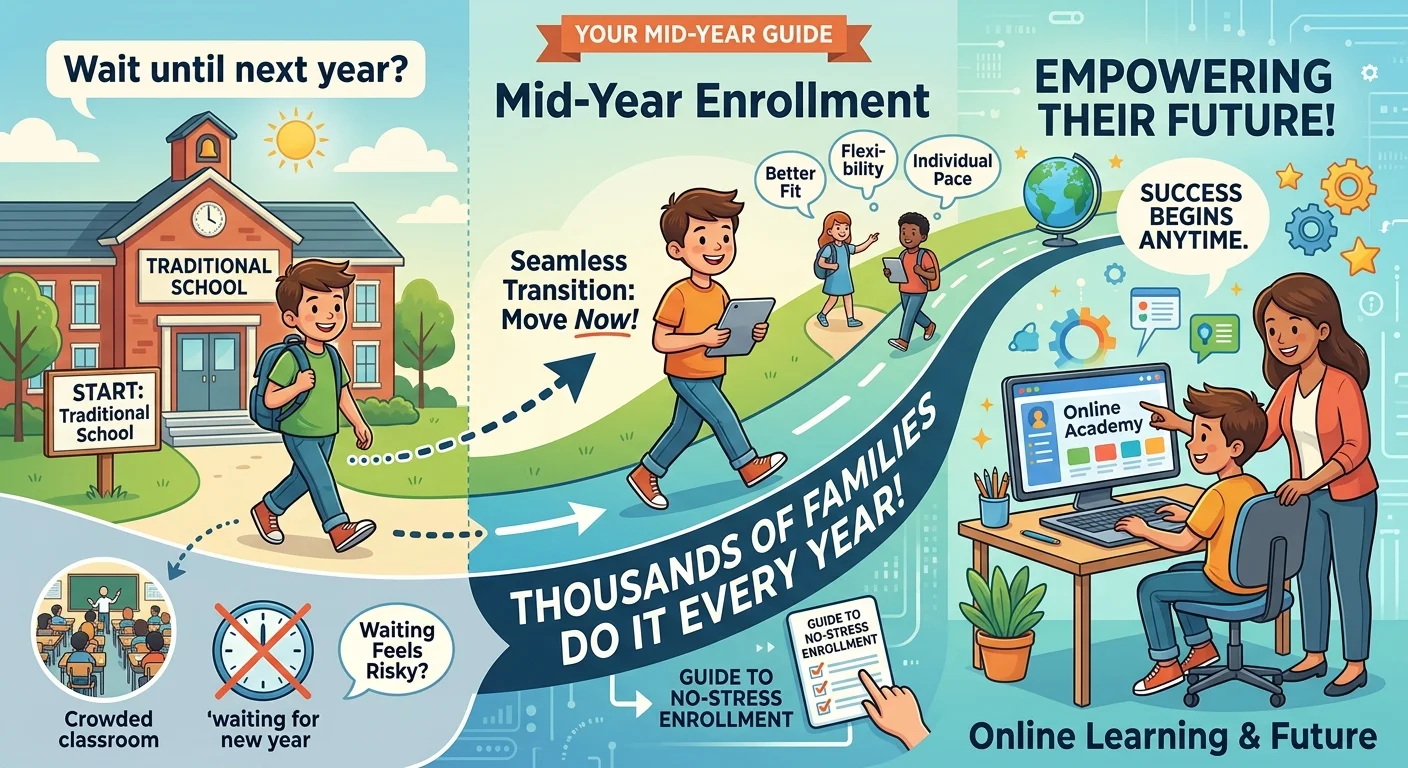
When September’s Plan Stops Working in January
You picked a school in August. You filled the forms, bought the uniform, packed the bag. Then, somewhere around November or December, things stopped working.
Maybe your child comes home quiet every day. Maybe grades are dropping and nothing you try at home is fixing it. Maybe your job moved you to a new city. Maybe your child has a health issue that a fixed classroom schedule cannot handle.
Parents also worry that switching to online school mid-year will disrupt their child’s learning. The concerns include:
Academic continuity:
Will the child fall behind in subjects like English or mathematics?
Curriculum alignment:
How will the new program match with existing standards such as Cambridge education or Oxford frameworks?
Social adjustment:
Can students adapt to virtual classrooms after spending months in traditional schools?
Administrative hurdles:
Parents fear paperwork, credit transfers, and technical setup will be too complex.
According to National Center for Education Statistics, over 3 million students in the U.S. enrolled in some form of online schooling in 2025, with a significant portion joining mid-year. This shows the practice is not unusual, but parents still face uncertainty.
During the 2022-2023 school year alone, 562,659 students were enrolled in virtual schools across prekindergarten through high school, according to ConsumerAffairs. That number stayed well above pre-pandemic levels, which shows families are not just trying online school out of emergency — they are choosing it and staying.
Safety is a big part of this. Only 45% of middle school parents feel confident their child is safe at school, according to Better Living. That is less than half. If you are one of the parents who checks that number and feels a knot in your stomach, you already know this is not a small issue you can wait out.
Academic struggle is the other common trigger. A child who is falling behind in October does not automatically catch up by June. In many cases, the opposite happens. According to Ignite Learning Academy, academic struggles top the list of reasons families look for alternatives mid-year — grades keep slipping, confidence drops, and the gap gets wider with every passing week.
So the real problem is not “should we change schools?” The real problem is: most parents believe they have to wait for a new school year to fix it, and that belief is wrong.
What Waiting Actually Costs Your Child
Here is what most parents do not think about. Waiting is not neutral. It is not “doing nothing while we plan.” Waiting has a cost, and the cost grows every month.
Here is what most parents do not think about. Waiting is not neutral. It is not “doing nothing while we plan.” Waiting has a cost, and the cost grows every month.

Academic gap:
If your child is struggling with a subject in November, that gap does not pause during the holidays. New material builds on old material. By the time June arrives, a small gap in October can turn into a full grade level behind. According to Florida Virtual School, families who delayed enrollment reported higher stress levels and lower grades compared to those who switched mid-year.
Confidence:
A child who feels behind starts avoiding the subject, then avoiding school talk altogether. The longer this goes on, the harder it becomes to reverse, even after the environment changes. Case studies from Legacy Traditional Schools show that mid-year transfers improved student engagement and reduced absenteeism.
Momentum toward flexible learning is already moving, not shrinking:
Look at Iowa as one example. Virtual school enrollment in the state jumped to 373% of pre-pandemic levels in 2020-21, then climbed again to 388% the following year, according to The 74. This was not a short-term panic reaction. Families who moved to online school stayed there, and more joined them the next year. Across ten states, average virtual enrollment settled at 176% of pre-pandemic levels in year two not a spike, a new normal.
“Fall start only” is a myth families believe without checking.
Many parents assume online schools only take new students in September, so they wait, and their child keeps struggling in a setting that clearly is not working. This single wrong assumption is the biggest reason families delay a decision that could help their child right now. Online programs often provide access to k12 online school resources, online high school credits, and specialized online school programs. Delaying enrollment means missing these benefits.
Relocation does not wait for a school calendar either:
A parent’s new job, a family move, or a change in living situation happens on its own timeline. Forcing your child’s education to wait for the “right” month adds a second disruption on top of the first one.
Every month of waiting is a month your child spends in a situation you already know is not working. That is the real agitation here, not the paperwork, not the logistics, but the quiet cost of sitting on a decision you have already made in your head.
How Mid-Year Enrollment Actually Works
Here is the good news. Mid-year enrollment is a normal, well-established process. It is not a special exception schools grudgingly allow most online schools are built for it.
According to Connections Academy, students can transfer to an online school at any point during the school year. Families are simply encouraged to let their child finish earning current semester credits where possible, so the transition lines up cleanly with the new school’s grading period. That is a small planning detail, not a barrier.

This holds true across the board — whether you are looking at a K-12 online school, a well-known network like Legacy Traditional Schools, or online school programs built around a specific curriculum. Even online law school and other higher-education programs generally run on rolling admission, so the “wait for fall” rule is not really a rule at all.
Step-by-Step: What to Actually Do
Step 1: Research Accredited Programs
Look for schools aligned with Cambridge International exams or Oxford standards. Accreditation ensures smooth credit transfer. According to Cambridge International Education, over 10,000 schools worldwide follow Cambridge standards, making transitions easier.
Step 2: Understand Curriculum Compatibility
Parents should compare syllabi. For example, University of Cambridge UK provides detailed outlines for primary and secondary levels. Matching subjects like English, science, and mathematics helps avoid duplication or gaps
Confirm the enrollment window:
Most online schools use rolling admission, meaning they accept new students all year, not just in September. Check the specific school’s calendar so you know the next available start date.
Step 3: Manage Administrative Requirements

Most online school programs require transcripts, previous report cards, and proof of residency. According to SchoolMyKids, parents who prepare documents early reduce enrollment delays by 40%.
Gather your child’s records.
You will typically need:
Birth certificate or ID
Immunization records
Most recent report card or transcript
Any special education or learning support documents, if applicable
Submit the application:
Most applications, like CCA’s, are short online forms. You are usually asked about grade level, curriculum interest (for example, Cambridge or IGCSE), and household contact details. Many schools also offer a free consultation call before you fill out the enrollment form, so you can ask about course load, class size, and whether books and course materials are shipped or provided digitally.
Let the new school request records:
A good online school will contact your child’s current school directly for transcripts, so you are not stuck chasing paperwork between two offices.
Attend orientation:
This is where your child learns to use the learning platform, meet teachers, and understand the daily schedule before classes actually start.
Set a start date and stick to a routine:
Pick a start date, even if it is a Wednesday. A clear date gives your child a mental line between “the old school” and “the new one,” which helps them settle in faster.
Step 4: Support Social Transition

Encourage children to join online clubs, discussion forums, or peer study groups. Case studies from King’s InterHigh show that students who engaged in extracurricular online activities adapted faster
Step 5: Monitor Progress
Use built-in dashboards offered by k-12 online schooling platforms. According to EdTech Review, 70% of parents reported improved visibility into their child’s performance after switching mid-year.
Case Study Examples
Case Study: How One Online School Handles Mid-Year Transfers

Commonwealth Charter Academy (CCA), a Pennsylvania-based online school, is a useful case study because it shows what a smooth mid-year process actually looks like in practice.
- The full application takes about 15 minutes to complete online.
- The school itself handles the withdrawal notice to the student’s previous school, so parents do not have to manage that paperwork alone.
- New families go through a “Great Start” orientation, which introduces the online platform and prepares the student before their first live class.
(Source: Better Living)
This case study matters because it breaks the myth that switching schools mid-year means weeks of confusing paperwork. In a well-run online school, the heavy lifting — records requests, platform setup, and orientation is handled by the school, not the parent.
Florida Virtual School (U.S.):
Families cited flexibility and teacher support as top reasons for mid-year enrollment. According to FLVS, 85% of parents felt their child’s academic confidence improved within three months.
King’s InterHigh (UK):
Accredited by Ofsted, it allows mid-year transfers into Cambridge and IB programs. According to the Ofsted Report , students maintained grade-level performance after switching mid-year.
SchoolMyKids (India):
Reports show digital learning growth in India, with hybrid models supporting mid-year enrollment. According to SchoolMyKids 60% of parents preferred online schooling for flexibility.
What Parents Usually Worry About

“Will my child fall behind switching mid-year?”
Usually the opposite happens. Online programs let a student work at their own pace on a subject, instead of being pushed forward through material they have not mastered yet, according to Ignite Learning Academy. A child who was behind in a fixed classroom often catches up faster once the pace matches their actual level.
“Will my child lose friendships or social contact?”
This is a fair concern, and it is worth planning for directly, keep existing friendships active outside school hours, and look for a school that runs live classes and clubs, not just recorded lessons.
“Is my child too young or too old to switch mid-year?”
No. Mid-year transfers happen across every level, from primary school through high school. The process and paperwork stay largely the same regardless of grade.
“How do I find the best program for my child?”
Ask each school about their course catalog, teacher-to-student ratio, and how they prepare older students for college or university applications. The best online school for your family is the one whose program matches your child’s grade level, curriculum, and pace: not just the one with the most ads.
“What if we started the wrong curriculum?”
This comes up often for families comparing Oxford vs Cambridge programs, or moving between local and international curricula. A mid-year switch is actually a good time to correct this, since you avoid finishing a full year on a track you plan to leave anyway. Schools like Nisar Academy run Cambridge and Oxford IGCSE curriculum alongside Islamic Education from Playgroup through O Level, so families switching mid-year can move onto one consistent track instead of patching together two systems.
Making the First Month Smooth
The enrollment paperwork is the easy part. The first month is where the real adjustment happens. A few things help:
Keep a school-like schedule at home, even though there is no commute. Fixed start times help children treat online school as real school, not an extended holiday.
Talk to teachers early, not just when a problem shows up. Most online schools assign a single point of contact for new families in the first few weeks.
Give it a full month before judging it. Any new system, online or in-person, takes a few weeks to feel normal.
Practical Tips for Parents

Primary school students:
Focus on core subjects like reading and mathematics.
Middle school students:
Ensure a smooth transition in science and social studies.
High school students:
Pay attention to credit transfers for graduation requirements.
Specialized programs:
Options like online law school or advanced course modules may require additional approvals.
Final Thoughts

If your child is struggling right now, September is not a magic reset button: it is just a date on a calendar. Online schools are built to take new students throughout the year, whether your student is in primary school or working toward a high school diploma, and the paperwork is lighter than most parents expect. The data shows families who make this move tend to stay with it, not regret it.
The real decision was probably made weeks ago, the first time you noticed something was wrong. The enrollment process is just the part where you act on it.