
Children’s learning difficulties don’t always look like bad grades. Sometimes they look like tears over homework, a stomachache before school, or a bright kid who suddenly says “I’m just dumb.” This guide explains the signs parents should watch for, why ignoring them can worsen outcomes, and practical solutions backed by case studies and research.
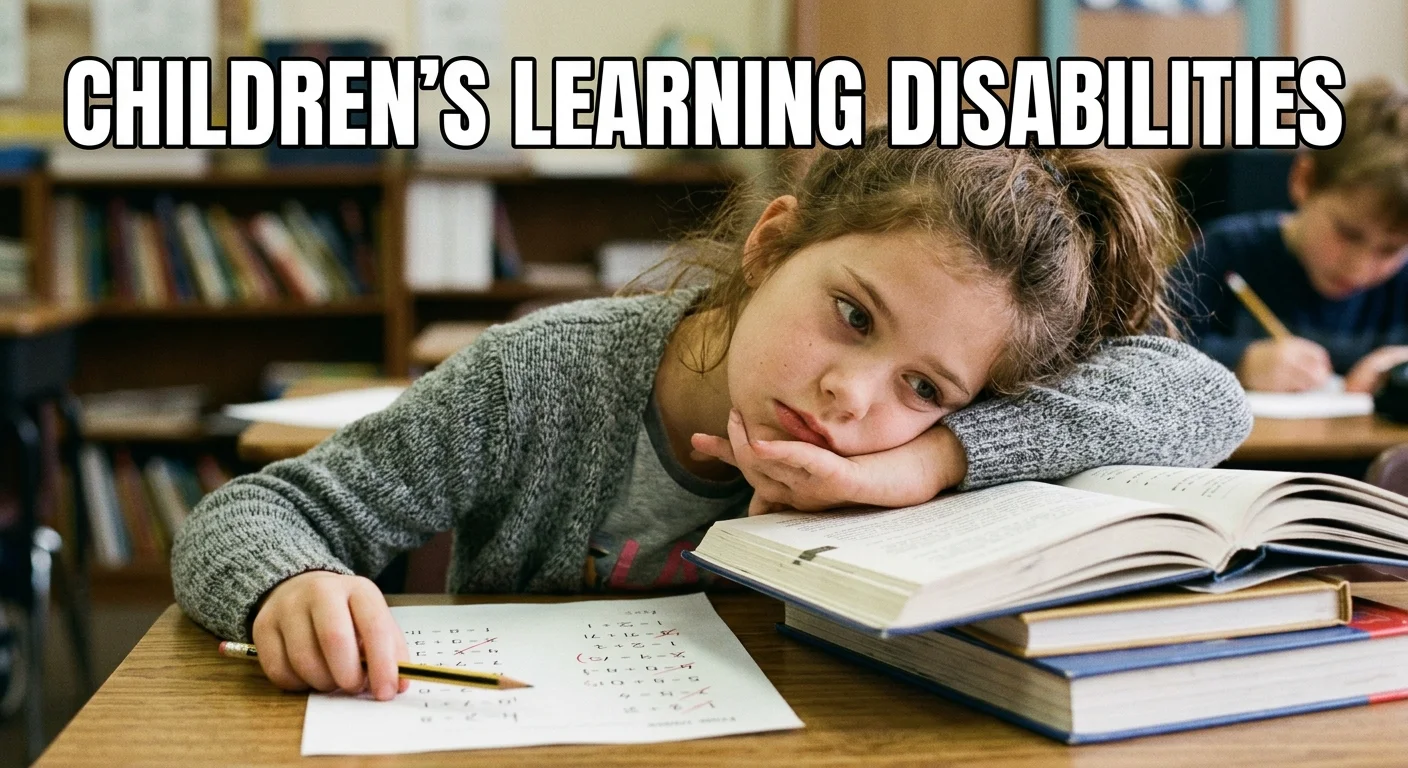
Something Is Off, But You Can’t Name It
You know your child. So when something shifts, you feel it before you can explain it.
Maybe your son used to love reading and now avoids it. Maybe your daughter cries over math homework that used to take ten minutes and now takes two hours. Maybe the teacher keeps sending notes home, and each one stings a little more.
This is the quiet start of children’s learning difficulties. Not a diagnosis. Not a label. Just a pattern that keeps repeating.

Here’s the hard part: most parents don’t act right away. They wait. They tell themselves it’s a phase, or the teacher is too strict, or the child just needs to “try harder.” That waiting feels safe. It isn’t.
Children’s learning difficulties are more common than most parents realize. According to Statista, citing CDC and NCHS data, about 11% of boys and 6% of girls in the U.S. under 18 have been identified with a learning disability. According to a study published in the journal PLOS ONE, parent-reported learning disability diagnoses among U.S. children rose from 7.86% in 2016 to 9.15% in 2023 — a jump of over 16% in just eight years.
That’s not a rare problem tucked away in special education rooms. That’s roughly one child in every ten. Likely one in your child’s own classroom.
Children’s Learning Difficulties Get Worse the Longer You Wait: Agitating the Problem
Here’s what most parents don’t get told: children’s learning difficulties don’t stay the same size. They grow.
A child who struggles quietly with reading in first grade doesn’t just “catch up” on their own most of the time. The gap tends to widen, year after year, because school moves forward whether the child is ready or not. By third grade, students aren’t just learning to read: they’re reading to learn everything else: science, math word problems, social studies. If reading is shaky, every other subject wobbles with it.
The numbers back this up. According to a study published on PMC (National Institutes of Health), more than 33% of fourth graders in the U.S. scored below basic on the national reading comprehension assessment. For some groups, that number was over 50%. This wasn’t a small, fixable issue. It was a widespread pattern that had been building for years before anyone stepped in.
And the fallout isn’t just academic. According to TotalCareABA, over 18% of kids with learning disabilities drop out of school entirely: a rate far higher than their peers. The same source notes that unaddressed learning struggles are linked to low self-esteem, social isolation, and bullying, because kids who fall behind often get treated as “slow” by classmates long before anyone understands why.

Let’s be blunt about what this means:
- A child who isn’t struggling with ability starts believing they’re struggling with worth.
- Confidence drops before grades do. Grades drop after confidence is already gone.
- Every month of silence is a month the gap gets a little wider and a little harder to close.
Research on students with or at risk for dyslexia backs this pattern up directly. A large meta-analysis published in Reading Research Quarterly (Wiley) reviewed 53 studies covering more than 6,000 students and found that earlier intervention consistently produces stronger reading outcomes than intervention started later. In plain words: the earlier you catch it, the easier it is to fix. The longer you wait, the harder the climb.
This is the part parents need to sit with. It’s not about panicking. It’s about understanding that “let’s wait and see” is itself a decision, and it’s usually the wrong one.
Know the Signs, Then Act
Good news first: children’s learning difficulties are very treatable when caught early. You don’t need to diagnose your child yourself. You just need to notice the pattern and get them help before the gap grows.
Signs of Children’s Learning Difficulties: Does Your Child Need Extra Academic Support?
Watch for these. One sign alone might mean nothing. Several signs of Children’s Learning Difficulties that show up again and again are worth paying attention to.
- Grades or test scores are sliding: Not one bad test. A pattern, quiz after quiz, month after month, in the same subject.
- Homework takes far longer than it should: A 20-minute assignment that eats up two hours, most nights, is a signal, not laziness.
- Your child avoids reading, writing, or math: Kids who struggle often develop avoidance habits: “I forgot my book,” “I don’t feel good,” “Can I do it later?”
- Negative self-talk shows up: “I’m stupid.” “I’m bad at school.” “I’ll never get this.” Confidence damage is often the loudest signal of all.
- Trouble following multi-step instructions: If your child needs each step repeated separately, or gets lost halfway through a task, that’s worth noting.
- Physical complaints before school or homework: Stomachaches, headaches, or sudden tiredness that shows up right when it’s time to study, this is often anxiety, not illness.
- Teachers keep raising the same concern: One comment might be nothing. The same comment across two or three report cards is a pattern, not a coincidence.
- Reversing letters or numbers past the age when peers stop: Some reversal is normal early on. If it continues well past age 7 or 8, it’s worth a closer look.
- Difficulty remembering what was just read or taught: Not forgetting facts from last month — struggling to recall something from five minutes ago.
- Big gap between effort and results: This is the one parents feel most. Your child is trying — genuinely trying, and the results still don’t match the effort. That mismatch is rarely about motivation.
Case Study: A Realistic Example of Children’s Learning Difficulties
A Cambridge International case study followed a 10-year-old student diagnosed with dyslexia. Initially, the child avoided reading and showed declining grades. After an evaluation, the school implemented an IEP with multisensory reading strategies and assistive technology. Within one year, the student improved reading comprehension by 30% and regained confidence in class participation.
This demonstrates how structured intervention can transform outcomes for children’s learning difficulties.
According to Cambridge English’s teacher guide, structured multisensory strategies and exam preparation support significantly improve reading comprehension for children with dyslexia Cambridge English, 2023. Similarly, Cambridge University Press research confirms that tailored interventions help students overcome barriers in reading, writing, and organization Cambridge University Press & Assessment, 2023.
How to Actually Help With Children’s Learning Difficulties
Here’s where most advice gets vague. Let’s not do that. Here’s what actually works, based on research — not guesswork.
Step 1: Get a real evaluation, not a guess:
Ask the school for a formal academic assessment, or see an educational psychologist. A proper evaluation is the only way to confirm whether you’re dealing with a genuine children’s learning disability or a temporary gap. You need data, not just a feeling, data tells you exactly where the gap is (reading fluency? number sense? working memory?) so the help is targeted, not generic.
Step 2: Start structured, one-on-one support, fast:
This is where the research on children’s learning disability support is loudest. A randomized controlled trial published in ScienceDirect tested a scalable one-on-one tutoring program with 818 kindergarten students who were identified as emergent readers. The finding was consistent with a large body of prior research: personalized, one-on-one instruction delivered over an extended period produced the largest gains — far more than computer programs used alone.

A similar pattern showed up in a randomized controlled trial published in Taylor & Francis Online involving 72 Danish first-graders at risk of reading difficulties. Students who received structured, multi-sensory tutoring showed measurable gains in decoding, letter knowledge, and phonological awareness compared to those who didn’t.
And in a program reviewed on PMC (NIH), students who received the SMART tutoring program showed significantly greater improvement in word identification and reading fluency than students who didn’t get tutoring, with effect sizes considered moderate to strong by researchers. Notably, this program worked even though the tutors weren’t extensively trained, showing that consistency and structure matter as much as expertise.
The pattern across all this research is the same: for a child with a learning disability, one-on-one, consistent, structured support, not occasional help, is what moves the needle.
Step 3: Rebuild confidence alongside skills:
For a child with a learning disability, skills and confidence grow together, not one after the other. Praise effort and small wins out loud. Avoid comparing your child to siblings or classmates.
Step 4: Keep Communication Open About Your Child’s Learning Disability
Ask teachers for specifics: which subject, which skill, how often. Vague feedback isn’t useful. Specific feedback tells you exactly where to focus support for your child’s learning disability.
Step 5: Be Consistent, Not Intense, With Children’s Learning Disability Plan
Short, regular sessions beat long, occasional ones. Twenty focused minutes, four days a week, will do more than a two-hour cram session once a week.
Technology Tools for Children’s Learning Difficulties
Technology won’t replace one-on-one support, but the right tools can reinforce it between sessions. Used alongside, not instead of, structured tutoring, these tools can make daily practice around children’s learning difficulties easier to stick with:
- Text-to-speech and read-aloud apps: help kids with dyslexia access grade-level content without decoding every word alone.
- Speech-to-text tools: let a child with dysgraphia get ideas down without the writing process getting in the way.
- Math visualization apps: turn abstract number concepts into something a child with dyscalculia can actually see and manipulate.
- Structured practice apps with spaced repetition: reinforce reading or math skills in short, low-pressure daily sessions rather than long cram sessions.
- Audiobooks paired with the printed text: build reading fluency and comprehension together, especially useful for children learning difficulties tied to processing speed.

The research above found that consistency and structure, not fancy tools, drive results. So the best use of technology for children’s learning difficulties is as a support to daily practice, not a substitute for a tutor or teacher who can adjust to your child in real time.
The Bottom Line on Children’s Learning Difficulties
Children’s learning difficulties are common, real, and — this is the important part — very manageable when caught early. Roughly 1 in 10 children shows signs of a learning disability, according to national data. But research also shows, again and again, that early, structured, one-on-one support closes the gap faster than waiting ever will.
You don’t need to have all the answers today. You need to stop waiting and start watching for the signs, then take the first step: a conversation with the teacher, a formal evaluation, or a session with a tutor who can give your child focused, consistent attention.

The child who’s struggling right now isn’t behind for good. They’re just waiting for the right kind of help, at the right time. That time is now.
If you’re looking for that kind of focused, one-on-one support regarding Children’s Learning Difficulties Nisar Academy offers personalized online classes from Playgroup through O Level, built around each child’s pace rather than a fixed curriculum speed

FAQs on Children’s Learning Difficulties
What are 5 common learning difficulties in children?
The most common forms of children’s learning difficulties are dyslexia (reading), dysgraphia (writing), dyscalculia (math), auditory processing difficulty (understanding spoken language), and ADHD-related attention and focus difficulties. Children’s learning difficulties often overlap, thats why a child may show signs of more than one at once.
How to identify a child with a learning disability?
Identifying children’s learning difficulties starts with watching for patterns, not single bad days, in grades, homework time, confidence, and teacher feedback. The next step is a formal academic assessment through the school or an educational psychologist, which pinpoints exactly which skill (reading fluency, working memory, number sense) is affected.
How to help a child with intellectual disability?
While intellectual disability is different from children’s learning difficulties, the support approach is similar: get a formal evaluation, break tasks into small steps, use repetition and visual aids, and work with a specialist who can build a plan matched to the child’s pace. Consistency and patience matter more than speed.
What are the treatment options for specific learning disabilities?
There’s no medical “cure” for children’s learning difficulties, since they’re not ill; there are differences in how the brain processes information. The main options are structured one-on-one tutoring, specialized reading or math programs, speech or occupational therapy where needed, and classroom accommodations such as extra time or modified assignments.
How to treat a child with a learning disability?
Treating children’s learning difficulties works best through structured, one-on-one instruction delivered consistently over time, paired with confidence-building and open communication with teachers. Research shows early, targeted intervention produces far stronger results than waiting or relying on general classroom instruction alone.