
The best English learning apps can make English practice easier, but the right app depends on your level, goal, and daily routine. Instead of downloading ten apps and using none of them consistently, choose one main app, add one supporting tool, and follow a simple month-by-month path.
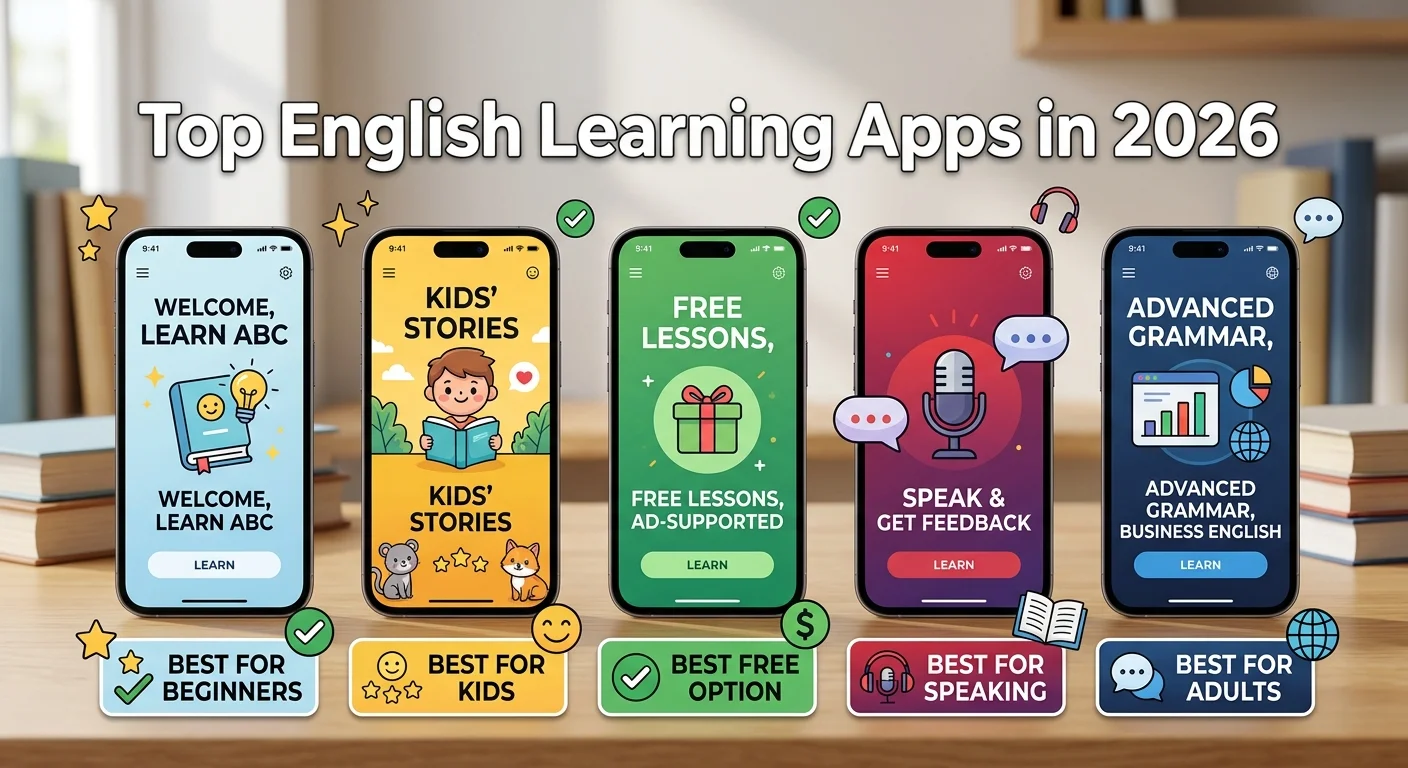
Why Choosing an English App Feels So Difficult
If you search for the best English learning apps, you will quickly find hundreds of recommendations. One article says you should use a vocabulary app. Another says you need an AI speaking tutor. Someone else says grammar is the most important thing, while another person tells you to watch videos all day.
That advice can be confusing, especially if you are a beginner. You may download three or four best English learning apps, use each one for a few days, and then stop because you do not know what to study next.
The good news is that you do not need a complicated system. The best English learning apps are simply tools. Your real progress comes from using the right tool for the right skill at the right stage.
This guide gives you a practical six-month roadmap. You will start with basic English, build listening and speaking skills, improve your writing, and then move toward workplace, school, travel, or exam English.

Month 1: Build Your English Foundation
The first month is about creating a strong base. Do not try to learn advanced vocabulary or complicated grammar yet.
Choose one of the best English learning apps as your main learning tool. For a structured beginner course, Busuu is a useful option because its English program covers structured levels and its courses focus on real-life communication.
Skills to learn
- Basic greetings and introductions
- Numbers, dates, time, and days
- Family and personal information
- Common verbs
- Present simple
- Basic question forms
- Pronouns
- Everyday vocabulary
- Basic sentence structure
- Listening to short conversations
- Saying simple sentences aloud
You can also use Duolingo for short daily practice. Duolingo has redesigned major courses around CEFR levels, and its English course includes practical language situations at higher levels.
At the end of Month 1, move from simply understanding English to using it in short conversations.
Month 2: Improve Listening and Everyday Speaking
Once you understand basic sentences, your next problem is usually listening. Many learners know grammar on paper but cannot understand someone speaking at normal speed.
This is where the best English learning apps should be combined with real English listening.
Skills to learn
- Listening for key words
- Common expressions
- Everyday questions
- Asking for clarification
- Pronunciation of common words
- Present, past, and future basics
- Short conversations
- Listening without translating every sentence
- Repeating sentences aloud
- Building useful phrases instead of isolated words
For structured lessons, Babbel offers short lessons with listening, speaking, writing, grammar exercises, and real-life dialogues.
For free listening practice, VOA Learning English is another strong resource. Its beginner programs are designed by certified American English teachers, and its material covers speaking, vocabulary, and writing.
Month 2 prepares you for exactly this type of everyday communication.
Month 3: Build Speaking and Pronunciation
This is the stage where many learners get stuck. They can understand English but feel nervous when they have to speak.
The best English learning apps for this stage should give you opportunities to speak, listen to yourself, and receive feedback.
Skills to learn
- Word pronunciation
- Sentence stress
- Intonation
- Speaking in complete sentences
- Describing your day
- Asking and answering questions
- Giving opinions
- Role-playing common situations
- Speaking without preparing every sentence
- Correcting repeated pronunciation problems
ELSA Speak is especially useful for pronunciation practice. Its AI analyzes pronunciation and provides feedback on sounds, stress, and intonation.
Another option is HelloTalk, which connects language learners with language partners and includes English-learning options.
By the end of Month 3, your goal is not perfect English. Your goal is to speak without freezing.
Month 4: Strengthen Reading, Vocabulary, and Writing
Now that you have basic speaking confidence, increase the amount of English you read and write.
The best English learning apps can help with vocabulary, but you should also learn words in context. Memorizing long lists of unrelated words is rarely enough.
Skills to learn
- Reading short articles
- Finding the main idea
- Understanding context
- Common phrasal verbs
- Useful collocations
- Writing short paragraphs
- Writing emails
- Connecting ideas
- Using punctuation correctly
- Checking grammar after writing
Use the Cambridge Learner’s Dictionary when you meet unfamiliar words. It provides simple definitions, audio pronunciation, and thousands of examples.
For broader reference, Cambridge Dictionary includes learner, academic, and business dictionaries, with British and American pronunciation.
Month 4 turns your English from classroom knowledge into useful written communication.
Month 5: Move From General English to Your Goal
At this point, stop studying everything. Start studying the English you actually need.
This is where the best English learning apps should be selected according to your purpose: work, university, travel, interviews, or exams.
Skills to learn
- Business vocabulary
- Academic vocabulary
- Interview English
- Presentation English
- Travel English
- Formal emails
- Opinions and arguments
- Longer conversations
- Industry-specific vocabulary
- Note-taking
Busuu, for example, offers an English for Business course covering topics such as job hunting, interviews, business emails, negotiations, and meetings.
If your goal is an English exam, use official preparation resources rather than relying only on general language apps.
IELTS official resources explain that IELTS assesses listening, reading, writing, and speaking separately.
For TOEFL preparation, ETS TOEFL provides official preparation resources covering reading, listening, speaking, and writing.
Month 6: Test Yourself in Real Situations
The final month of this roadmap is about performance.
You should now spend less time asking, “Which are the best English learning apps?” and more time asking, “Can I actually use English?”
Skills to practice
- Five-minute conversations
- Job interviews
- Presentations
- Email writing
- Reading articles
- Listening to longer conversations
- Explaining a problem
- Giving your opinion
- Summarizing information
- Speaking without a script
That is the level of practical communication you should aim for.
If you can use English in real situations, the best English learning apps have done their job.
Best English Learning Apps: Which One Should You Choose?

There is no single winner for every learner. The best English learning apps depend on what you need.
For beginners
Busuu is useful if you want structured lessons and real-life communication practice. Its English course follows CEFR levels and covers skills from beginner through advanced levels.
For daily habit building
Duolingo is a good choice if short, game-like lessons help you stay consistent. Its courses include CEFR-aligned content for several major languages.
For structured lessons
Babbel is worth considering if you prefer short lessons that combine grammar, listening, speaking, and real-life dialogues.
For pronunciation
ELSA Speak is a strong supporting tool for pronunciation and speaking feedback.
For listening
VOA Learning English provides beginning, intermediate, and advanced material, including news, videos, podcasts, and grammar resources.
For vocabulary and definitions
Cambridge Dictionary is a useful reference because it gives definitions, pronunciation, and real examples.
For conversation with other learners
HelloTalk can provide opportunities to communicate with language partners.
For students who want teacher-led support instead of learning entirely through apps, Nisar Academy also provides online English learning and tuition support.
Why This Structured Path Works
- Month 1: Build basic vocabulary, grammar, and sentences.
- Month 2: Train your ear and understand everyday English.
- Month 3: Speak more and improve pronunciation.
- Month 4: Strengthen reading, vocabulary, and writing.
- Month 5: Focus English on your school, career, travel, or exam goal.
- Month 6: Test your English in realistic situations.
The important idea is progression. You do not need all the best English learning apps at once.
Common Mistakes to Avoid
- Downloading too many apps.
- Changing your main app every week.
- Learning vocabulary without using it in sentences.
- Studying grammar but never speaking.
- Speaking only when you feel “ready.”
- Watching English videos without actively listening.
- Memorizing difficult words you rarely use.
- Ignoring pronunciation.
- Trying to sound like a native speaker instead of trying to be clear.
- Preparing for IELTS with only a general English app.
- Spending more time researching the best English learning apps than actually studying.
- Expecting fluency after a few weeks.
- Comparing your progress with someone else’s.
- Studying for two hours once a week instead of practicing regularly.
What Employers and Other People Actually Look For
Learning English is not just about knowing grammar rules. Real communication requires both technical language skills and soft skills.
Technical English skills
- Grammar accuracy
- Useful vocabulary
- Reading comprehension
- Listening comprehension
- Clear pronunciation
- Professional writing
- Email writing
- Presentation language
- Industry-specific terminology
For example, IELTS tests listening, reading, writing, and speaking as separate language skills.
Soft skills
- Confidence
- Active listening
- Clear communication
- Problem solving
- Teamwork
- Asking questions
- Explaining ideas
- Giving and receiving feedback
- Speaking politely
- Adapting your message to the audience
LinkedIn’s 2024 B2B Marketing Benchmark listed communication, analytical skills, problem-solving, teamwork, and presentations among skills being added to professional profiles.
This is why the best English learning apps should be treated as practice tools, not as the entire learning system.
A Simple Daily Routine
You do not need a complicated timetable.
Try this:
10 minutes: Complete your main app lesson.
10 minutes: Listen to English from VOA, a podcast, or another reliable source.
10 minutes: Speak aloud. Describe your day, answer a question, or repeat useful sentences.
5 minutes: Check new words using Cambridge Dictionary.
5 minutes: Write three to five sentences.
That is 40 minutes.
If you only have 15 minutes, reduce each activity. The goal is consistency.
VOA’s own English-learning guidance recommends choosing a regular study time, setting achievable goals, and practicing with another person.
Real Case Studies: Do English Learning Apps Actually Help?

Case Study 1: Busuu and Independent English Learners
A large-scale study conducted by Fernando Rosell-Aguilar, a Senior Lecturer at The Open University, examined how learners used the Busuu language-learning app. The study received 4,095 responses, including 2,265 people learning English. Most learners used the app several times a week, and many sessions lasted between 16 and 30 minutes. Learners particularly valued vocabulary, listening, and grammar practice.
The study also found that 82% of respondents agreed that Busuu helped improve their language knowledge, while 92% said the app met or exceeded their expectations. This supports the idea that a structured app can be useful when learners use it regularly rather than simply downloading it and abandoning it.
Case Study 2: Duolingo in a University English Course
A 2023 study published in PASAA: Journal of Language Teaching and Learning in Thailand examined the use of Duolingo with 128 Thai university students taking English for Professional Purposes. The students were divided into a Duolingo-user group of 70 and a non-user group of 58. Researchers used pre-tests and post-tests to examine students’ knowledge of English verb tenses.
The researchers found that students who used Duolingo showed a significantly greater improvement in verb-tense knowledge. The study also found positive relationships between how frequently students used the app, their perceived achievement, their enjoyment, and their performance.
This is useful for beginners because it shows why regular practice matters. An app can be particularly helpful for a specific skill, such as grammar, when learners use it consistently as part of a broader learning plan.
Case Study 3: ELSA Speak and English Pronunciation
A 2024 case study at Can Tho University of Technology in Vietnam examined the use of ELSA Speak with 63 English-major freshmen and sophomores. Students learned English fundamentals in class and then used ELSA Speak for practice at home over three months.
The researchers reported noticeable improvements in students’ pronunciation and communication confidence. The study highlighted the value of the app’s ability to help learners identify and correct pronunciation problems during individual practice.
This is a useful example for learners who understand English but feel uncomfortable speaking it. Instead of spending all their study time learning more vocabulary, they can use a pronunciation-focused tool to identify specific speaking problems.
These examples point to the same practical lesson: the best English learning apps are most useful when learners use them consistently, focus on specific skills, and combine app practice with broader English activities.
Conclusion
The best English learning apps are not magic shortcuts. They are tools that help you practice the right skill at the right time.

Start with basic English. Then improve listening, speaking, reading, and writing. After that, focus on the English you actually need for work, school, travel, or exams.
You do not need ten apps. You need one clear plan, regular practice, and enough patience to keep going.
If you are choosing among the best English learning apps, remember this simple rule: pick one main app, add one supporting resource, and use English in real situations every week.
Progress may feel slow at first. That is normal. If you keep practicing, the sentences that once felt difficult will eventually become the sentences you use naturally.
FAQs About the Best English Learning Apps
What are the best English learning apps for beginners?
Duolingo, Busuu, and Babbel are good choices for beginners because they offer simple, structured lessons in vocabulary, grammar, listening, and everyday English.
What are the best English learning apps for kids?
Duolingo ABC, Lingokids, and Studycat are good options for children because they use age-appropriate games, stories, activities, and vocabulary practice.
What are the best English learning apps for free?
Duolingo, BBC Learning English, VOA Learning English, and Cambridge Dictionary offer useful free English-learning resources. You can combine them to practice different skills.
What are the best English learning apps for adults?
Busuu, Babbel, Duolingo, and Memrise are useful for general adult English. ELSA Speak can be added if pronunciation and speaking are your main goals.
Are the best English learning apps enough to become fluent?
Not by themselves. The best English learning apps can help you build skills, but you should also practice speaking, listening, reading, and writing regularly.
How many best English learning apps should I use?
Start with one main app and one supporting resource. Using a few tools consistently is usually better than downloading many best English learning apps and using none regularly.
Which of the best English learning apps is best for speaking?
ELSA Speak is useful for pronunciation and speaking feedback, while HelloTalk can help you practice conversations with other language learners.
Can children and adults use the same English learning apps?
Some apps can be used by both, but children usually need age-appropriate activities, while adults may need English for work, study, travel, or exams.