
Raising Muslim kids abroad is not simple. Between school pressure, cultural gaps, and thin community support, many parents watch their Muslim kids drift from faith without meaning to. This blog explores real case studies, highlights common struggles, and offers practical solutions for families raising Muslim kids in diverse societies.
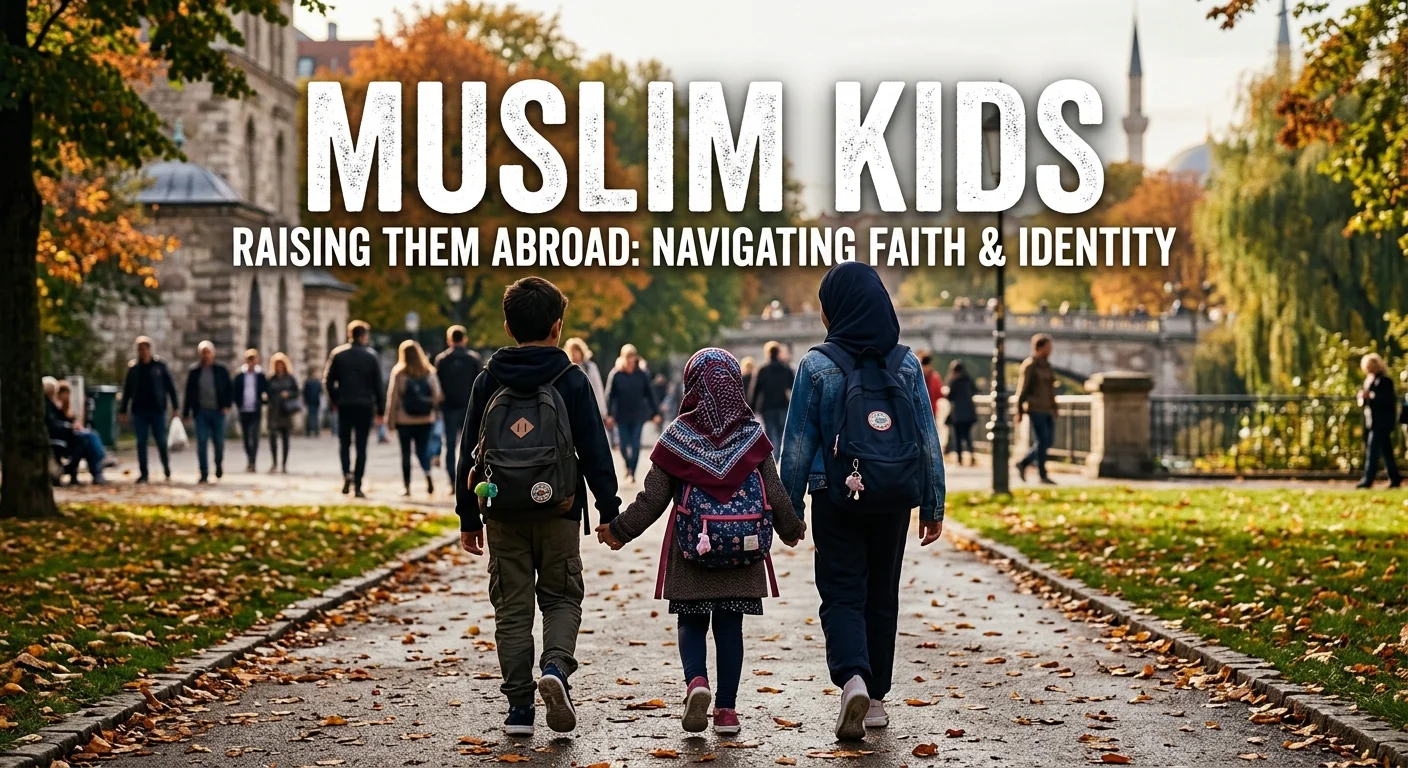
Muslim Kids Are Growing Up Between Two Worlds
If you are raising Muslim kids abroad, you already know the feeling. You send your child to school in the morning, and by the afternoon they come back with questions you were not ready for. Why do we pray five times a day when nobody else does? Why can’t I eat what my friends eat at the birthday party? Why do we dress differently?
This is not a small issue. It is the daily reality for millions of families. The Muslim population in North America grew by 52% between 2010 and 2020, reaching close to 5.9 million people, according to Pew Research Center. In Europe, Muslims made up about 6% of the population by 2020, with much of that growth driven by migration, according to Pew Research Center. That means more and more Muslim kids are being raised in places where Islam is a minority faith, not the default.
Numbers alone don’t tell the full story. Muslim kids in Western schools face something most other kids don’t have to think about: proving their identity is not a threat. A national survey found that 42% of Muslim parents with children in K-12 schools reported their child was bullied because of their faith, according to the Institute for Social Policy and Understanding (ISPU). In nearly a third of these cases, the bully was a teacher or school official, not another student, according to ISPU.
Read that again. Muslim kids are not just dealing with peer pressure. Some are dealing with hostility from adults who are supposed to protect them. That is the real problem parents are up against when raising Muslim kids abroad. It is not one bad influence or one bad school. It is a whole environment that was not built with Muslim kids in mind.
What Happens When Muslim Kids Are Left Without Support
Here is where it gets harder. If Muslim kids abroad don’t get the right support at home and in their education, the gap between their faith and their daily life keeps growing. And that gap does not stay small. It widens every year.
The Split-Identity Problem
Think about what a typical week looks like for many Muslim kids abroad. Five days of school built around a curriculum, calendar, and social culture that has nothing to do with Islam. Weekends split between homework, sports, and maybe an hour of Quran class if the family can find time.

No real space to ask deep questions about faith. No teacher who understands why Ramadan matters. No classmate who eats the same halal lunch. Muslim kids end up learning to keep two separate identities: one for school, one for home. That split identity is exhausting, and it does not go away by itself.
The Mental Health Cost
The mental health data on this is hard to ignore. Repeated exposure to bias and bullying is linked to long-term mental health struggles among Muslims, and the research shows that the younger a child is when this exposure starts, the higher the risk of depression, anxiety, and post-traumatic stress later on, according to a summary of ISPU findings by the National Alliance on Mental Illness Maryland chapter. This is not a minor inconvenience. This is a mental health issue playing out inside your child’s school day.
Identity Confusion and Rising Islamophobia
Now add on the identity confusion. Muslim kids abroad are the youngest and most digitally connected generation of Muslims in history. Social media use is highest among 18-to-29-year-olds, and that same age group has grown up entirely in a period marked by scrutiny and stereotyping of Muslim communities, according to ISPU’s 2025 American Muslim Poll. That means the influences shaping a young Muslim’s sense of self are coming faster and louder than ever, often from platforms with zero connection to Islamic values.
The pressure is not easing either. A national index measuring anti-Muslim sentiment jumped from 25 in 2022 to 33 in 2025, according to ISPU’s Islamophobia Index data, and researchers have separately noted that racism and bias act as toxic stressors on Muslim kids’ development, according to ISPU’s report on race and American Muslim youth.
Put this together and here is the real risk. Muslim kids who don’t get consistent Islamic grounding at home and school don’t just “figure it out later.” Many quietly disconnect. They stop asking questions about faith because nobody around them treats those questions as normal.
They start associating Islam with awkwardness instead of identity. And by the time parents notice, the child is a teenager who sees prayer as an obligation instead of a relationship with Allah. This is the outcome every parent raising Muslim kids abroad is trying to avoid, whether they say it out loud or not.
The Cost and Access Problem
There’s also a practical side agitating this problem: money and access. Full-time Islamic schools do exist, but they are limited. Research counted around 235 full-time Islamic schools in the US, growing to roughly 300 to 320 schools serving more than 50,000 students in more recent counts, according to a study published via Project MUSE. That sounds like progress until you realize these schools are concentrated in a handful of states, mostly California, Texas, New York, and Florida, and several US states have no Islamic school at all, according to the same research shared on Islamic Horizons.
If you are a Muslim family in a smaller city, a rural area, or a country like Canada, parts of Europe, or the UAE where full-time Islamic schools are even harder to find, your options shrink fast. Average annual Islamic school tuition also runs $6,000 to $7,000 per student and can reach as high as $10,000 a year at some offline schools, which is out of reach for many families, according to data reported in a study on the impact of COVID-19 on Islamic schools and confirmed by Zaid Academy’s review of Islamic homeschooling costs.
On top of cost, most Islamic schools are also fairly young institutions, with 55% having operated for six years or less, which raises real questions about long-term stability, according to Sound Vision’s review of schooling options for Muslim children.
So here is where most parents land. Local Islamic school is too far, too full, or too expensive. Public or private secular school doesn’t teach Deen. Weekend Islamic classes are too short to build real knowledge. And the child is stuck in the middle, absorbing bits and pieces of both worlds with nothing tying them together.
A Shift Toward Alternatives
This gap is exactly why more Muslim families are turning to alternatives outside the traditional school-or-nothing choice. Muslim families were among the fastest-growing groups in the homeschooling movement during and after the pandemic, alongside Indigenous and Hispanic families, according to The Hechinger Report.
More broadly, over 5% of American children aged 5 to 17 received home-based or full-time virtual education in the 2022-2023 school year, and that number kept climbing through 2024 and 2025, according to Clarion India’s coverage of a Muslim family’s homeschool journey. Muslim parents are not walking away from education. They are walking toward a version of education that actually fits their kids.
A Real Plan for Raising Muslim Kids Abroad
The good news is this problem has a solution, and it does not require moving back to a Muslim-majority country. Muslim kids abroad can grow up confident in their faith and strong in academics. It takes intention, structure, and the right support system. Here is what actually works.
1. Give Muslim kids a curriculum that combines both worlds, not two separate tracks:
The biggest mistake is treating Islamic education and academic education as two unrelated boxes to check. Muslim kids need one coherent path where Quran, Islamic studies, and Tarbiyah sit alongside Cambridge, Oxford, or IGCSE-style academics, not as an afterthought squeezed into a Sunday school hour. When faith and academics are taught together instead of in competition, Muslim kids stop seeing Islam as separate from “real school” and start seeing it as part of who they are.

This is exactly the gap online Islamic academies are built to close. A structured online program lets Muslim kids anywhere, whether they’re in Rawalpindi, Toronto, London, or Dubai, get consistent Quran memorization, Islamic Education, and Tarbiyah on the same schedule as their math, science, and English classes.
No commute needed, no waiting list for a local Islamic school, no compromise on either subject. Nisar Academy is one example of this model in action, combining Cambridge and IGCSE academics with Islamic Education and Tarbiyah for students from Playgroup through O Level.
2. Build daily habits, not occasional lessons:
Muslim kids need consistency more than intensity. Five minutes of Quran recitation every day beats one long session once a week. A short daily reminder about a Prophet’s story or a Sahabi’s character builds identity slowly and permanently. Parents raising Muslim kids abroad should treat Deen like a daily subject, not a special occasion.

3. Talk openly about the hard questions instead of avoiding them:
Muslim kids abroad will be asked why they fast, why they cover, why they don’t date, why they pray. If parents don’t prepare them with confident, simple answers, the first explanation a child hears might come from someone with no understanding of Islam at all. Practice these conversations at home. Let Muslim kids feel proud explaining their faith instead of embarrassed by it.
4. Connect Muslim kids with a real community, even if it’s online:
Isolation is one of the biggest risk factors for drifting away from faith. Muslim kids need to see other Muslim kids their age praying, learning Quran, and celebrating Eid. If the local community is small, online classmates and teachers fill that gap. Knowing you are not the “only one” changes everything for a child’s confidence.
5. Choose safety and quality, the same way Islamic school parents do:

Parents who enroll children in full-time Islamic schools consistently point to two reasons beyond religious teaching: academic quality and a safe, psychologically supportive environment, according to research cited in a Project MUSE practitioner’s note. That same standard should apply to any program raising Muslim kids abroad, online or in person. Look for qualified teachers, real accountability, and a curriculum that is actually followed, not just advertised.
6. Track progress the way you would with any serious subject:
Muslim kids should have clear Quran memorization targets, Islamic studies milestones, and character development goals, just like they have report cards for math and science. What gets measured gets taken seriously, by the child and by the parent.

Case Study Highlights
Cross-Cultural Learning and Identity (Malaysia & Turkey)
- A 2025 study in Jurnal Pendidikan Agama Islam Indonesia examined 15 Muslim students from Indonesia, Malaysia, and Pakistan studying abroad in Turkey and Malaysia.
- Findings: Muslim kids developed stronger religious identity through five processes: reflective faith development, adaptive worship practices, intercultural dialogue, community-based support, and global Muslim identity.
- According to JPAII, students reported spiritual resilience and deeper religious understanding while maintaining Islamic values in pluralistic environments.
Faith Practices as Literacy Learning (Afghan Muslim Kids in Australia)
- A case study in The Australian Journal of Language and Literacy found that Afghan Muslim children in Australia used faith practices (like Quran recitation and prayer) as literacy learning tools.
- According to Springer, these practices helped Muslim kids strengthen identity and language skills simultaneously.
Islamic International School in Yogyakarta (Indonesia)
- A 2025 case study of Global Islamic School (GIS) Yogyakarta showed how Islamic-based international education fosters globally minded Muslim kids.
- Approach: GIS integrated global citizenship competencies with Islamic values, using bilingual learning days, international competitions, and trips abroad.
- According to DOAJ, Muslim kids developed intercultural competence while maintaining strong faith identity.
Case Study Comparison
| Case Study | Location | Focus | Impact on Muslim Kids |
| JPAII Study | Malaysia & Turkey | Cross-cultural learning | Strengthened faith identity, resilience, intercultural dialogue |
| Afghan Kids Study | Australia | Faith practices as literacy | Improved literacy + reinforced Islamic identity |
| GIS Yogyakarta | Indonesia | Islamic international school | Balanced global citizenship with Islamic values |
Bringing It Together
Raising Muslim kids abroad will always come with extra work. There is no school system abroad that was built with your child’s Deen in mind, and pretending otherwise only delays the problem. But the data also shows something encouraging: the Muslim community abroad is growing, Islamic education options are expanding, and more families than ever are actively choosing to combine faith with modern academics instead of picking one over the other.

Muslim kids don’t need to be shielded from the modern world to stay grounded in Islam. They need parents who are intentional, a curriculum that treats faith and academics as partners, and a community that reminds them they are not alone. Get those three things right, and Muslim kids abroad won’t just survive between two worlds. They will grow up confident in both