
Islamic values are the foundation of a strong family life. By practicing them daily, parents can nurture faith, discipline, and compassion in their children. This post will give you 15 simple, real-life ways to bring Islamic values back into daily routines, backed by actual data and studies. You do not need to be a scholar to raise a child with strong Islamic values, you just need a plan.
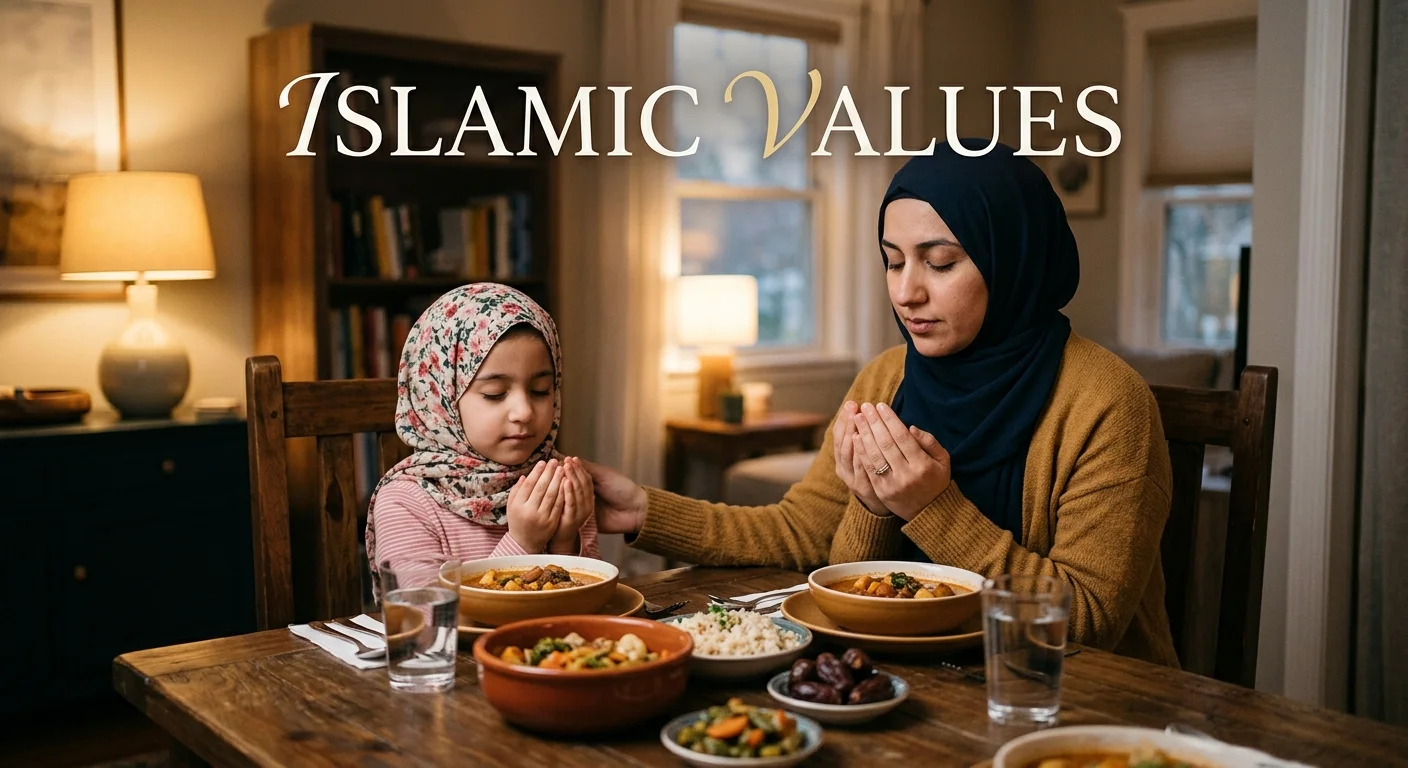
Islamic Values Are Getting Pushed to the Side
Many families today struggle to maintain Islamic values at home. With busy schedules, digital distractions, and outside influences, children often grow up disconnected from their faith.
Let’s be honest. Most Muslim parents want to raise their kids with strong Islamic values. But wanting something and doing something are two different things.
Mornings are rushed. School runs till the afternoon. Homework eats up the evening. Screens fill whatever time is left. By the time everyone sits down for dinner, nobody has the energy to talk about Islamic values, let alone practice them.
This is not a made-up problem. According to Pew Research Center, about 42% of Muslim adults are currently raising a minor child at home, and Muslim households skew younger than most other religious groups. That means millions of parents are trying to pass down Islamic values while juggling work, school runs, and screen time battles, all at once.
And the strange part? Most parents are not lazy or careless. They simply do not have a clear system for teaching Islamic values at home. Nobody handed them a checklist. Nobody sat them down and said, “Here is how you build Islamic values into a normal week.” So Islamic values become something that happens “when there is time,” which, in most homes, is never.
There is also a second, quieter problem. Many parents assume that sending kids to Islamic school, weekend Quran class, or an online academy is enough on its own. It is not. Islamic values need repetition inside the home too, not just inside a classroom. A child can memorize surahs at school and still not carry patience, honesty, or gratitude into how they act at home, because school time and home time are treated as two separate worlds. Islamic values only become real when both worlds say the same thing.
What Happens When Islamic Values Are Left to Chance
Here is where it gets uncomfortable. If Islamic values are not built into daily life on purpose, they do not just stay flat. They fade.

When Islamic values are not practiced at home, children may lack spiritual grounding. They may adopt habits that conflict with their faith, such as dishonesty, disrespect, or neglecting prayer. A study by Institute of Social Policy and Understanding found that Muslim youth who do not practice faith at home are twice as likely to feel isolated in society. This shows the urgent need for families to create a strong Islamic environment at home.
Think about it like a plant. You do not water it once a year and expect it to grow. Islamic values work the same way. A child who hears about honesty once during Ramadan and then never again will not carry honesty as a core value. It becomes a “Ramadan thing,” not a “life thing.”
According to Pew Research Center’s Religious Landscape Study, the intergenerational transmission of religious identity from parents to children is around 85% among Muslim families in the US, which is actually higher than most other groups. That sounds good on the surface. But transmission of identity is not the same as transmission of daily Islamic values. A child can call themselves Muslim and still have no working habit of honesty, patience, gratitude, or kindness rooted in Islamic values, because nobody built those Islamic values into the actual rhythm of the house.
Now look at the bigger picture. Research from Harvard’s T.H. Chan School of Public Health, covered by Forbes, followed more than 5,000 young people for up to 14 years. The study found that children who grew up with regular religious practice were about 18% more likely to report being happy in their twenties compared to those who did not. This is not a small number. This is a real, measured outcome tied directly to how a child is raised, and Islamic values sit right at the center of that kind of upbringing for Muslim families.
So what happens when Islamic values are left to chance? You get kids who know facts about Islam but do not live by Islamic values. You get teenagers who can recite rules but cannot explain why those rules matter. You get young adults who drift, not because they rejected Islamic values on purpose, but because Islamic values were never really built into their daily life in the first place. The cost of ignoring this is not small. It shows up years later, when it is much harder to fix.
There is a data point worth pausing on here too. The same Pew study on religious upbringing found that among adults who say religion was very important to their family growing up, only 55% say religion is very important in their own life today, according to Pew Research Center. That means almost half of kids raised in a religious home do not carry that importance forward as adults. Growing up around Islamic values does not automatically mean growing up with Islamic values. The gap between the two is exactly what this list is meant to close.
The good news is that this is fixable. And it does not require a complicated system. It requires small, repeated actions.
15 Simple Ways to Build Islamic Values at Home
Here are 10 simple, practical ways to build Islamic values at home. None of these need special training. None of these need a big budget. They just need consistency.
1. Start the Day With One Line of Dua
Islamic values start with intention, and intention starts the moment your child wakes up. Teach your child a short dua for waking up. Say it together every morning, out loud, for one week straight. This is one of the smallest but most repeated ways to build Islamic values, because it happens every single day without needing a special moment. A study by ISNA found that shared du’a increases family unity and spiritual awareness.
2. Daily Prayer Routine
One of the strongest Islamic values is discipline through prayer. But most families expect kids to “figure it out” alone. Instead, pray together as a family, even if it is just one prayer a day. According to Pew Research, 59% of Muslim adults report praying multiple times a day. If parents model this Islamic value visibly, kids copy it without being told to.
3. Qur’an Reading Together
Set aside a short, fixed block, 15 minutes is enough, for Qur’an reading as a family. Start with short surahs kids already know. This is not about long recitation sessions. It is about making Qur’an time a normal part of the day, the same way reading a bedtime story is normal, so that connecting with the Qur’an becomes one more quiet, repeated way to build Islamic values. According to Yaqeen Institute, families who practiced Qur’an reading together reported stronger emotional bonds.

4. Charity at Home
Give your child a small, physical way to give; coins in a jar for someone in need, or a bag of food packed together for a neighbor. Let the child hand it over themselves when possible. Charity taught through mosque donations alone stays abstract to a child. Charity practiced at home, with a face and a hand involved, sticks as a real Islamic value instead of a Friday routine.

5. Respect for Parents
Respect for parents is one of the most repeated Islamic values in the Qur’an and hadith, but it is often taught as a rule to follow rather than something to practice. Build it into daily language instead, a child kissing a parent’s hand before school, asking permission before leaving a room, or simply saying thank you after a meal someone cooked. Small, repeated gestures teach this Islamic value far better than a single stern reminder. According to Al-Azhar University, respect for parents is one of the most emphasized Islamic values.
6. Halal Lifestyle
A halal lifestyle covers more than food; it includes what plays on the TV, what games are downloaded, and how money is earned and spent. Walk through your home once with your child and talk through a few choices together: why this show is fine and that one is not, why this snack is halal and that one needs checking. Making the reasoning visible, instead of just enforcing rules quietly, turns “halal” from a restriction into an understood Islamic value.
7. Talk About Honesty Using Real Examples, Not Lectures
Islamic values like honesty stick better through stories than through rules. Instead of saying “lying is haram,” tell a short, real story, from your own life or from Seerah, where honesty had a cost but was still the right choice. Kids remember stories. They forget lectures.
8. Show Gratitude Out Loud, Every Single Day
Gratitude is a core Islamic value, but it is rarely modeled out loud. Say “Alhamdulillah” for specific things, not just as a habit phrase. “Alhamdulillah the weather was nice today” teaches more than saying it without meaning. Kids learn Islamic values by watching how adults actually use them in daily language.
9. Give Kids Small Responsibilities Tied to Islamic Values
Responsibility is an Islamic value connected directly to amanah, or trust. Give your child one small, repeated task, feeding a pet, helping a sibling, tidying a shared space, and connect it directly to the idea of amanah. This turns an abstract Islamic value into something a child can physically do and feel proud of.
10. Read One Short Story From the Life of the Prophet ﷺ Each Week
Seerah stories are full of Islamic values in action, mercy, patience, fairness, and courage. You do not need a long session. Ten minutes once a week is enough. Kids connect Islamic values to real people faster than connect them to abstract rules.
11. Correct Mistakes With Mercy, Not Shame
How you correct a child teaches Islamic values just as much as what you say. Islam teaches mercy alongside accountability. When a child makes a mistake, correct the action calmly, without attacking the child’s character. This models one of the most important Islamic values — mercy — in real time, not just in theory.
12. Celebrate Islamic Values, Not Just Islamic Events
Most families celebrate Eid and Ramadan big, but let Islamic values slide the rest of the year. Instead, occasionally celebrate a value directly, praise a child specifically for honesty, patience, or kindness, the same way you would praise good grades. This tells a child that Islamic values matter every day, not just during religious seasons.
13. Get Involved in Mosque and Community Activities Together
Take your child to mosque events, community iftars, or local Islamic charity drives, and go as a family rather than dropping them off alone. A 2025 study in the American Journal of Community Psychology found that how parents pass down religious identity to their Muslim American children is closely tied to how civically and communally engaged those children become as young adults. Community involvement is not separate from Islamic values at home, it is where those values get tested and practiced outside the house.
14. Model Modesty in Speech and Dress, Don’t Just Enforce It
Modesty is an Islamic value that sticks better when a child sees it lived, not just policed. Talk through your own choices out loud, why you dress a certain way, why you avoid certain language, instead of only correcting the child’s choices. Explained modesty becomes an owned Islamic value. Enforced modesty stays a rule waiting to be broken.
15. Introduce Children to Real Islamic Role Models
Beyond the Prophet ﷺ and his companions, introduce children to local role models too, an imam they know, a teacher at their Islamic school, a community elder who is known for kindness. Seeing an Islamic value lived out by someone they can actually meet makes it far more real than a value they only read about in a book.
A Few Common Questions Parents Ask
What if my child resists?
That is normal. Do not turn Islamic values into a punishment or a lecture topic. Keep the tone light and short. A one-minute conversation repeated daily builds Islamic values far better than a twenty-minute talk given once.
What if I am not consistent myself?
Start anyway. Kids do not need a perfect parent to learn Islamic values. They need a parent who keeps trying, out loud, in front of them. Consistency over time matters more than getting it right every single day.
A Quick Case Study: Small, Repeated Actions Beat Big, Rare Ones

Here is something worth sitting with. The Harvard-affiliated study mentioned earlier, published in the American Journal of Epidemiology, tracked children from adolescence into their twenties over 8 to 14 years. It measured regular practice, not occasional big events, as the strongest predictor of long-term well-being. Regular, small, repeated religious practice outperformed occasional, big religious moments every time.
This matches exactly what this list is built around. You do not need one big “Islamic values day” once a year. You need a handful of small habits, repeated weekly, that quietly build Islamic values into the normal rhythm of your home. Small and repeated beats big and rare, every single time.
Final Thoughts on Building Islamic Values at Home
Building Islamic values at home is not about doing everything perfectly. It is about doing a few simple things consistently. Pick two or three ideas from this list. Start this week. Do not wait for Ramadan or a “better time,” because that time rarely comes on its own.
Islamic values grow the same way anything else grows, through daily attention, not yearly effort. Start small, stay consistent, and let Islamic values become part of how your home actually runs, not just what your home believes in.
If you want this same consistency carried into your child’s schooling, not just at home, Nisar Academy builds Islamic Education and Tarbiyah into every grade level alongside the Cambridge and IGCSE curriculum, so Islamic values are not left to a single weekly class.

Frequently Asked Questions About Islamic Values
What are the main values of Islam?
The main values of Islam include honesty, patience, gratitude, humility, justice, mercy, respect for parents, charity, and trustworthiness (amanah). These Islamic values are drawn from the Qur’an and the life of the Prophet ﷺ, and they are meant to be practiced daily, not just remembered as ideas.
What are the 7 basic beliefs of Islam?
The 7 basic beliefs, also called the Articles of Faith (Iman Mufassal), are: belief in Allah, belief in the angels, belief in the revealed books, belief in the prophets, belief in the Day of Judgment, belief in divine decree (Qadar), and belief in life after death. Some scholars group the last two together, listing 6 core beliefs instead of 7, but the content covered is the same.
What are the core moral values of Islam?
The core moral values of Islam center on honesty, justice, kindness, humility, patience, and good character (akhlaq). These moral Islamic values are meant to shape how a Muslim treats family, neighbors, and strangers alike, not just how they worship.
What is the 7-7-7 rule in Islam?
The 7-7-7 rule is a popular parenting framework, often attributed to Hazrat Ali (RA), that divides childhood into three 7-year stages: play and affection from birth to age 7, teaching and gentle discipline from 7 to 14, and friendship and guidance from 14 to 21. It is a widely used teaching tool for building Islamic values at each age, though it is worth noting scholars point out it is not a direct, formally authenticated hadith, so it is best treated as helpful parenting wisdom rather than strict religious law.
What are the 10 moral teachings of Islam?
Ten commonly cited moral teachings of Islam are: worship Allah alone, honor your parents, speak the truth, keep your promises, give charity to those in need, be just even with people you dislike, show mercy to the weak, avoid arrogance, protect what is entrusted to you (amanah), and maintain good character (akhlaq) in all dealings. These teachings sum up much of what this article has already covered as Islamic values in practice.