
Teaching Tarbiyah and academics together is not just possible, it is essential. Parents and educators must balance spiritual nurturing with modern schooling to raise children who succeed in both faith and academics. This blog explains the challenges, highlights case studies, and offers practical solutions for integrating Tarbiyah and academics in schools and homes.
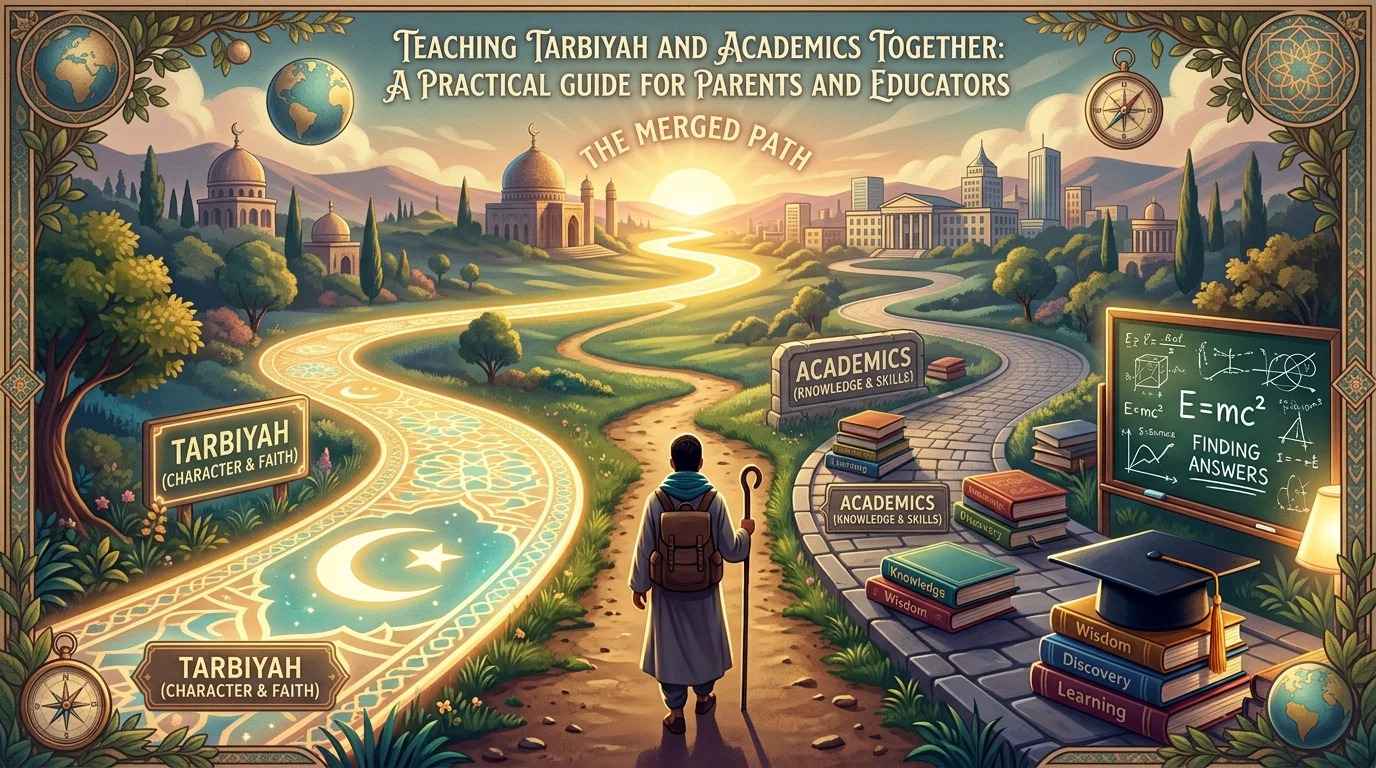
The Gap Between Tarbiyah and Academics
Most parents raising Muslim children face the same choice every year. Do they enroll their child in a school that pushes hard academics? Or do they choose a madrassah that focuses only on Quran and Islamic studies? Very few options combine Tarbiyah and academics into one program that treats both as equally important.
This gap is real. Traditional schools measure success with grades, test scores, and university admissions. Tarbiyah rarely gets a place on the report card. Meanwhile, many weekend Islamic programs teach Tarbiyah in isolation, disconnected from what the child is learning in math, science, or English during the week. The result is a child who lives two separate lives: one for school, one for faith.

Parents feel this tension every single day. They want their children to score well in Cambridge or IGCSE exams. They also want their children to pray on time, speak with honesty, and carry good akhlaq into adulthood. Right now, very few systems help them do both. Tarbiyah and academics are treated like oil and water, and that is the core problem this guide addresses.
What Happens When Tarbiyah and Academics Stay Separate
When Tarbiyah and academics stay disconnected, the damage shows up slowly, then all at once.
First, children start to see faith as a “weekend activity” rather than a way of life. If Tarbiyah only happens in a separate class, on a separate day, taught by a separate teacher, children learn to compartmentalize. Islam becomes something they do, not something they are.
Second, screen time fills the gap left behind. Children spend hours each day on devices, and that time shapes their values whether parents intend it or not. A recent meta-analysis reviewing 117 studies across more than 292,000 children found that heavy screen exposure drives emotional and behavioral problems, and those problems then push children toward even more screen time, according to Simply Islam. Without a strong Tarbiyah foundation running through daily learning, screens quietly become the main teacher.

Third, academic pressure without moral grounding often produces stress, not wisdom. Children learn to chase grades without learning why knowledge matters or how to use it responsibly. Islamic scholars writing on this topic note that when screens replace prayer, Quran recitation, and family conversation, children lose the quiet moments of reflection that build a spiritually grounded mind, according to IslamOnline.
Fourth, and most costly, is what happens by the time these children become teenagers. Without early integration of Tarbiyah and academics, teenagers often struggle to connect their identity to their faith. Research on Islamic character formation shows this gap is not just anecdotal. A study on halaqoh-based Tarbiyah programs found that structured moral instruction, when connected to daily learning, strengthens self-confidence and social awareness in adolescents, while its absence leaves a real and measurable gap, according to Iseedu Journal of Islamic Educational Thoughts and Practices.
This is the cost of keeping Tarbiyah and academics apart. It is not a small inconvenience. It shapes who a child becomes, and it is exactly why more parents are now searching for a real way to combine Tarbiyah and academics before that gap grows any wider.
How to Teach Tarbiyah and Academics Together
The good news is that Tarbiyah and academics work better as one system, not two. Here is a practical, step-by-step way to combine them, whether you run a school, homeschool your children, or teach online.
1. Start Every Subject With Intention, Not Just Content:
Before a math lesson, a science lesson, or an English lesson begins, take one minute to connect it to a value. A geometry lesson can open with a short line about Allah’s design in nature. A biology lesson on the human body can open with a reminder about amanah, or trust, over the body Allah gave us. This is not extra work. It is a five-minute habit that ties Tarbiyah and academics into a single learning moment instead of two separate ones.
2. Build Islamic Themes Into Core Subject Content:
Instead of treating Tarbiyah as a stand-alone subject, weave it into English essays, Urdu grammar, and reading comprehension. A narrative essay assignment can center on the life of the Holy Prophet ﷺ. A reading passage can be set in a local, culturally familiar setting. This approach makes Tarbiyah and academics inseparable in the child’s mind, because the child is practicing English skills and absorbing Islamic character lessons in the very same exercise.
3. Use a Real Curriculum Framework, Not Just Good Intentions:
Good intentions fade. A written framework does not. Map out exactly where Tarbiyah touches each subject, each week, for each grade level. Researchers studying Islamic curriculum design stress that schools achieve tarbiyah’s goals only when Islamic values are deliberately integrated into the curriculum and teaching methods, not left to chance, according to Yenni Zuraidah’s study on Islamic Education Curriculum. A written plan is what turns Tarbiyah and academics from a nice idea into a daily practice.
4. Train Teachers to Deliver Both, Not Just One:
A teacher who is strong in academics but untrained in Tarbiyah will default to academics alone under pressure. Teacher training must cover both. Studies on character building through Islamic learning found that a teacher’s pedagogical competence directly affects how well character values transfer to students, alongside their academic achievement, according to TARBIYA: Journal of Education in Muslim Society. If you want Tarbiyah and academics to succeed together, invest in teachers who can teach both with confidence.
5. Evaluate Both, Not Just One:
What gets measured gets valued. If report cards only track math and English scores, Tarbiyah quietly becomes optional. Build simple character checklists alongside academic report cards: honesty, punctuality for prayer, respect for teachers, kindness to classmates. Research on Islamic values in learning evaluation confirms that assessing character alongside academics is what actually strengthens the quality of Islamic education over time, according to Southeast Asian Journal of Islamic Education. Without evaluation, Tarbiyah and academics drift apart again, even in a well-meaning school.
6. Replace Passive Screen Time With Active Tarbiyah Habits:
Since screens fill the gap when Tarbiyah is missing, fill that same time with structured Tarbiyah habits instead. A short daily hadith discussion. A five-minute family Quran reading. A simple dua before homework. These small habits are Tarbiyah and academics working side by side in real time. They do not need to be long. They need to be consistent. Guidance for Muslim families on this topic recommends replacing unstructured screen time with meaningful shared activities that build both spiritual and family connection, according to IslamOnline.

Case Study: What the Research Shows About Tarbiyah and Academics
The Southeast Asia Study: Tarbiyah and Student Engagement:
Numbers make this case stronger than opinions do. A published case study examined the relationship between Tarbiyah Character Formation and student engagement using a sample of 250 students, selected through purposive and stratified random sampling with a 5 percent margin of error.
The study found a strong positive correlation between Tarbiyah character formation and student engagement and well-being, and it concluded that Tarbiyah is not separate from academic success but a core part of shaping students who are ready to contribute meaningfully, according to Yenni Zuraidah’s Islamic Education Curriculum study.
The North America Study: Tarbiyah Tracking and Discipline:
A similar pattern shows up closer to home for many overseas families. In North America, Islamic schools that put a structured, integrated Tarbiyah tracking system in place saw student discipline improve and behavioral issues drop by 40 percent, according to Ilmify.
This case study matters because it shows the same result in a completely different setting. Whether the school is in Southeast Asia or North America, when Tarbiyah and academics are tracked and taught together instead of being taught separately, discipline improves and engagement rises.
The Broader Research: SEL Programs and Academic Achievement
This finding lines up with broader education research too. A large meta-analysis reviewing 213 school-based social and emotional learning programs, covering 270,034 students from kindergarten through high school, found that students who received structured character and values instruction alongside academics gained an 11-percentile-point improvement in academic achievement compared to students who did not, according to the CASEL meta-analysis.

A more recent systematic review covering 33,737 students across grades one through twelve confirmed this same pattern: students in programs that combined character development with regular instruction consistently outperformed those in academics-only programs, according to this 2025 meta-analysis.
Additional research on ninth-grade students found that social and emotional skill-building, closely related to what Tarbiyah aims to build in Muslim children, directly shapes school climate and academic outcomes, according to this study published via PMC.
A bibliometric review from Portuguese schools reached a similar conclusion, noting that character and values instruction is now seen as essential to school success, not a distraction from it, according to this Frontiers in Psychology bibliometric study.
Even in distance learning settings, where structured Tarbiyah and academics are harder to combine, researchers found that students with stronger social-emotional competence showed better academic performance, according to The Critical Review of Social Sciences Studies.
The pattern across all of this research is the same. Tarbiyah and academics are not rivals. They are partners. Schools that treat them as one system see stronger, more well-rounded outcomes than schools that treat them as separate tracks.
Islamic Pedagogy: The Teaching Method Behind Tarbiyah and Academics
Islamic pedagogy is the teaching method that makes Tarbiyah and academics work as one system instead of two. It treats the teacher as a role model, not just an information source, and it treats every lesson as a chance to shape both mind and character.
Scholars reviewing the concept of tarbiyah note that it positions educators as facilitators of a learner’s fiṭrah, or natural disposition toward good, which reframes learning as an active, transformative process rather than simple memorization, according to this MDPI review of Islamic education literature.
This is the mindset shift schools need before Tarbiyah and academics can truly work together: teaching is not just about transferring facts, it is about shaping a whole person.
Parent Role in Tarbiyah: Why the Home Cannot Sit Out
Schools can only do so much. Parents carry the biggest share of the Tarbiyah and academics balance, because habits formed at home carry into the classroom and back again. The Prophet Muhammad ﷺ said, “Each of you is a shepherd, and each of you is responsible for his flock,” a hadith that places direct responsibility for a child’s upbringing on the parent, not the school alone, according to IslamOnline.

A parent who prays on time, speaks with honesty, and models patience is teaching Tarbiyah just as much as any classroom lesson. When home and school reinforce the same values, Tarbiyah and academics stop feeling like two separate jobs and start feeling like one shared goal
Teacher Training for Tarbiyah: The Missing Piece in Most Schools
A curriculum on paper means nothing if the teacher standing in front of the class was never trained to deliver it. Most teacher training programs focus entirely on subject mastery and classroom management, with little to no attention on how to model and teach Tarbiyah alongside a math or English lesson.

Studies on character building through Islamic learning confirm that a teacher’s pedagogical competence has a direct effect on how well students absorb character values, working hand in hand with their academic achievement, according to TARBIYA: Journal of Education in Muslim Society. Any school serious about combining Tarbiyah and academics needs to budget real time and real training for this, not treat it as something teachers will simply figure out on their own
Digital Tools for Tarbiyah: Making Tracking Practical
Tarbiyah used to be hard to measure. That is changing. Schools now use simple digital tools, from shared spreadsheets to dedicated apps, to track character milestones the same way they track test scores. This is exactly what made the difference in the North America case study covered earlier: a structured, integrated Tarbiyah tracking system, not just good intentions, is what drove the 40 percent drop in behavioral issues, according to Ilmify.

For online academies especially, digital tools are what make Tarbiyah and academics possible to run side by side across time zones, since teachers, students, and parents all need to see the same record in real time.
Tarbiyah in Diaspora Communities: A Different Kind of Pressure
Families living outside Muslim-majority countries face a version of the Tarbiyah and academics balance that comes with extra weight. Children grow up between two cultures, and research on Muslim families abroad confirms that family socialisation plays a major role in how well religious identity and practice transfer to the next generation, according to this study on Muslim diasporas in Europe. Without deliberate effort, children in diaspora communities can drift from their roots even while excelling academically. This is exactly why online Islamic academies matter so much for overseas families: they let children in Canada, Europe, or the UAE study a Cambridge or IGCSE curriculum while staying rooted in Tarbiyah, instead of choosing one over the other.
How Nisar Academy Puts This Into Practice
At Nisar Academy, Tarbiyah and academics run through the same curriculum, not two separate ones. Students follow Cambridge, Oxford, and IGCSE academic standards from Playgroup through O Level, while Islamic Education and Tarbiyah are built directly into daily lessons, not bolted on as an afterthought. A grammarworksheet might use culturally familiar, faith-centered examples.

A narrative essay assignment might center on the life of the Holy Prophet ﷺ set in a local context students recognize. This is what it looks like when Tarbiyah and academics are designed together from day one, rather than stitched together after the fact.
Families across Pakistan, Canada, Europe, and the UAE use this exact model online, proving that combining Tarbiyah and academics does not require a physical campus, only a clear plan and committed teachers. It also proves that Tarbiyah and academics can travel with a family wherever they live, without either one being left behind.
Conclusion
Tarbiyah and academics were never meant to compete. The problem was never Islam versus school, or faith versus grades. The real problem has always been a lack of a clear system to combine them. Once a school or a family builds that system, using intentional lesson planning, a written curriculum, trained teachers, engaged parents, and simple tracking tools,
Tarbiyah and academics start reinforcing each other instead of pulling in opposite directions. The case studies and research covered in this guide, from Southeast Asia to North America, all point to the same conclusion: children do better, behave better, and grow stronger in their identity when Tarbiyah and academics are taught as one.
That is the goal worth building toward, whether you are a parent raising one child at home or a school serving thousands online.