
You Want to Learn a New Skill, But You Don’t Know Where to Start
You open your laptop. You type “best online courses” into Google. You get 40 tabs open in ten minutes.
One website tells you Coursera is the only platform worth your time. Another says Udemy is cheaper and just as good. A third says skip both and go straight to YouTube. Somewhere in between, you find five “free courses online” that ask for a credit card before you even watch lesson one.

This is the real problem. It is not that online learning does not work. It is that there are too many course platforms, too many courses, and too much conflicting advice about which online course training actually leads somewhere- a job, a promotion, a real skill you can use on Monday morning.
Some people bookmark a dozen online lessons and never open them again. Others sign up for online certificate courses that turn out outdated the moment they start.
You do not have time to test 30 platforms yourself. You have a job, a family, or a business to run. You need one list. A working list. Not a list padded with random course titles nobody has actually finished.
The Cost of Picking Wrong Is Real
Here’s what happens when you pick the wrong platform.
You sign up for an online certificate program that looks impressive on the sales page. Three weeks in, you realize the content is outdated, the instructor never responds, and the certificate isn’t recognized by a single employer you’ve researched. You’ve lost money. Worse, you’ve lost time, and motivation is not something you get back easily once it’s gone.
Or you go the opposite direction. You try to save money by hunting for free courses online with certificates, and you land on a page that promises a “free certification online course” but hides three upsells before you can download anything. You spend more time avoiding scams than you spend learning.
Here’s a number that should make you pause: Google’s own internal data on its Career Certificates program shows that only 75% of graduates report a positive career outcome within six months, and that number includes people who got a raise at their current job, not just people who landed new roles, according to The Interview Guys and Grow with Google. That is Google’s flagship program, backed by 150+ employers in its hiring consortium, per OnlineCertHub. If the best-known name in online certificate courses only gets a 75% positive-outcome rate, imagine what happens when you pick a random course with no name recognition at all
This is why “just pick any online course” is bad advice. The wrong online class costs you money, time, and, worse, confidence in the idea of learning online at all.
A List Built on What Actually Works
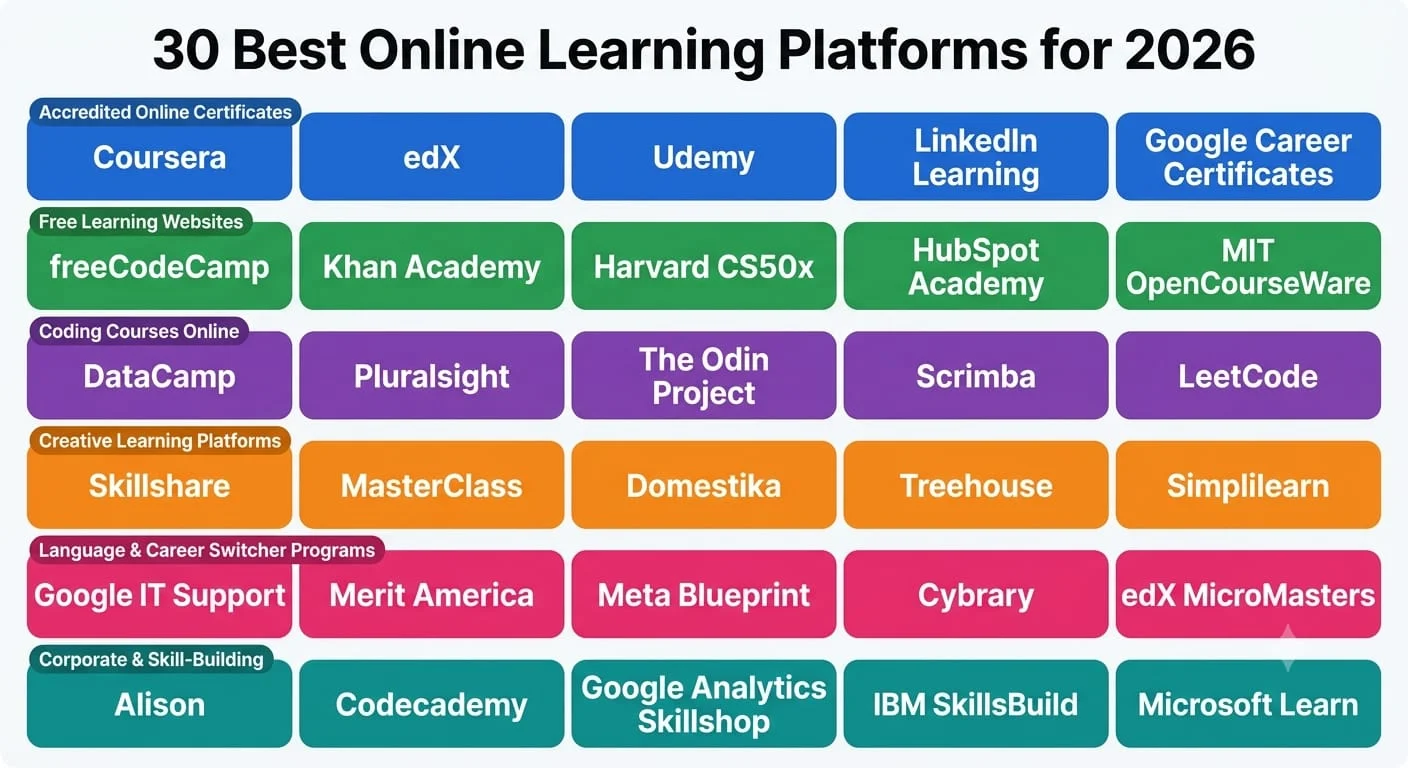
Here is the fix. Below are 30 online courses and learning websites for 2026, organized by what they’re actually good at, not ranked by hype. Some are online certificate programs. Some are entirely free courses. Some are classes online for a very specific skill. Use the one that matches your actual goal, not the one with the shiniest homepage.
Accredited Online Certificates
Accreditation is what separates a certificate you can put on a résumé from one that just sits in a folder. Coursera partners with 300+ universities including Stanford and Yale, and edX was co-founded by Harvard and MIT; both let you earn credentials tied to a real institution rather than a marketing team. Google’s Career Certificates sit slightly outside traditional accreditation but are backed by 150+ employers in an active hiring consortium, which is often more useful than a university crest if your goal is simply getting hired.
Before you pay for any accredited program, check two things: whether the certificate is issued by the institution by itself or just co-branded, and whether it’s recognized in the specific country or industry you’re targeting. A certificate that impresses employers in one market can mean very little in another, so a quick search for “[program name] + recognized by employers” before enrolling saves you from finding out the hard way.
Free Learning Websites
You don’t need a budget to start. freeCodeCamp, Khan Academy, and MIT OpenCourseWare are fully free, and freeCodeCamp alone has over 400,000 alumni citing its certifications in real job applications. Harvard’s CS50x is free to audit on edX and only charges for the verified certificate. The catch with free platforms is support; you’re mostly on your own, so they work best for self-motivated learners.
Coding Courses Online
Coding is the single most crowded category, so pick based on how you learn. freeCodeCamp and The Odin Project are free, project-heavy, and self-paced. Scrimba lets you edit real code in the video. Codecademy’s free tier is a fast way to test whether a language “clicks” before paying for anything. Once you’re ready for interviews, LeetCode is the standard practice ground computer science students turn to.
Language Learning Apps
Duolingo reported 50.5 million daily active users in Q3 2025 and generated roughly $1 billion in annual revenue, making it the dominant player in this category by a wide margin (Axis Intelligence). Babbel takes a different approach, paid-only, with revenue closer to $270–383 million driven partly by live classes and enterprise licensing rather than the gamified freemium model (LingoBright). If you want structured, teacher-led language instruction rather than app-based repetition, that’s closer to what a program like Nisar Academy’s English and Urdu courses are built for.
Corporate Training Online
The global corporate training market is valued at roughly $450–490 billion in 2026, and LinkedIn Learning currently leads that market with about a 24% share, ahead of Coursera for Business and Udemy Business (Skillademia). LinkedIn’s own data shows 78% of learners who complete a LinkedIn Learning course report a career benefit within six months, and employees who use the platform are 47% less likely to leave their company (Skillademia). If you’re choosing a platform for your team rather than yourself, that retention number is worth showing to whoever controls the training budget.
Best Overall Platforms for Online Courses With Certificates
Coursera:
Best for accredited certificates. It Partners with 300+ universities, including Stanford and Yale, and its Google Career Certificates alone have over 2.4 million enrollees on the Data Analytics track, per Internet of Learning and Careery.

It has a subscription at $59/month or $399/year; Coursera Plus gives you unlimited access to more than 7,000 courses for a single monthly fee (Internet of Learning). If you want an online certificate program backed by a real institution, start here.
Case study: Google Professional Certificate graduates reported average salary increases of 20% within 12 months.
2. edX:
Best for university-level credentials. Founded by Harvard and MIT. Most courses are free to audit; you only pay if you want the certificate. Its MicroMasters programs are one of the few online course tracks that can actually count toward a real master’s degree, according to Internet of Learning and UpskillWise. Price is $50–300 per certificate
Case study: MicroMasters graduates transitioned into data science and AI roles.
3. Udemy:
The largest course marketplace, with pricing that swings heavily on frequent discounts. It offers over 250,000 courses with lifetime access. Not accredited, but strong for learning one specific skill fast without committing to a long online certificate program, per SkillScouter and Stuart Kerrs. Its price is$12–200 per course
Case study: Small businesses saved 70% compared to in-person workshops by training staff via Udemy.
4. LinkedIn Learning:
Best for career professionals. Certificates attach directly to your LinkedIn profile, which recruiters see immediately (Skill Springer). Best for professionals upskilling in business tools and workplace software (SkillScouter).

Subscription is $19.99/month. Integration with LinkedIn profiles boosts employability
Case study: HR teams reported higher promotion rates among employees completing leadership tracks.
5. Google Career Certificates (via Coursera):
Covers IT Support, Data Analytics, UX Design, Project Management, Cybersecurity, Digital Marketing, and AI. Cost is about $49/month, most learners finish in 3–6 months, and median salaries for graduates range from $62,000 to $92,000 depending on the track (OnlineCertHub). Cybersecurity is currently the strongest track: the U.S. Bureau of Labor Statistics projects 33–35% job growth through 2034 for information security analysts — the fastest of any track Google offers, per The Interview Guys and InternBoard.
Best Free Courses Online (With Real Certificates)
6. freeCodeCamp:
Fully free, project-based coding curriculum. Over 400,000 alumni have cited its certifications in real job applications (Skill Learning Compass), and it currently offers 11 full curricula, each ending in a verifiable certificate (OnlineCertHub). This is one of the strongest examples of free online courses with certificates that actually mean something to employers.
7. Khan Academy:
100% free, no sign-up required, per Slant and BitDegree. No formal job-focused certificate, but unmatched for building a foundation in math, statistics, and the basics of programming logic (Alphonso Labs).
If you want the same early-years foundation with live teacher support instead of self-paced videos, Nisar Academy homeschool runs structured online classes from Playgroup through O Level on the Cambridge and IGCSE curriculum, alongside Islamic Education.

8. Harvard CS50x (via edX):
A free certificate after scoring 70%+ on the required problem sets and final project (DegreeCalc). One of the most respected free certification online courses in computer science.
9. HubSpot Academy:
Around 40 free certifications, well recognized specifically in U.S. marketing roles (OnlineCertHub).
10. Google Analytics Skillshop:
Free, official Google certification in analytics tools, useful for marketing and e-commerce roles.
11. IBM SkillsBuild:
A mix of free and paid tracks in technology fundamentals, AI, and cybersecurity basics.
12. Microsoft Learn:
Free learning modules with badges; some roll up into paid certification exams if you want to go further.
13. MIT OpenCourseWare:
Free access to actual MIT course material across nearly every subject. No certificate, but the depth is at the university level.
14. Alison:
One of the largest libraries of free courses online with certificates across a wide range of practical subjects, from workplace skills to health and safety.
15. Codecademy :
Interactive, browser-based lessons in a wide range of programming languages. The free tier is useful for testing whether a language “clicks” before paying.

Best Online Course Training for Tech and Data Skills
16. DataCamp:
Career tracks run 30–90 hours, designed to complete in 3–6 months (SkillScouter). Strong for data science, analytics, and Python/R skills with hands-on coding exercises.
17. Pluralsight:
Built specifically for IT professionals and software teams, with skill assessments that show exactly where your gaps are.
18. The Odin Project:
A free, bootcamp-quality full-stack web development curriculum, without the bootcamp price tag.
19. Scrimba:
Interactive, code-along video lessons for front-end development. You edit real code inside the video itself.
20. LeetCode:
Not a traditional course, but the standard place computer science students go once they start preparing for technical interviews.
If you’ve just finished Matric/O levels and are still deciding which computer course to pursue, Nisar Academy’s comparison of DIT vs Graphic Design breaks down which path fits which type of student before you commit to any platform below.
Best Classes Online for Creative and Practical Skills
21. Skillshare:
Classes are short, often 1–3 hours, focused on a single project. Dominant for creative skills like design, illustration, and video editing.
22. MasterClass:
Instructor-led video courses from recognized professionals across writing, cooking, business, and the arts.
23. Domestika:
A strong option for creative, hands-on classes online in illustration, photography, and craft-based skills.
24. Treehouse:
Around 300 courses, best suited to someone focused specifically on web design and mobile development basics.
25. Simplilearn:
Partnered with universities and companies for structured online course training, though quality and support have drawn mixed reviews.
Best Online Certificate Program for Career Switchers
26. Google IT Support Professional Certificate:
Targets a median entry-level salary around $65,000, with hundreds of thousands of related job openings tracked in recent years (BestJobSearchApps).
27. Merit America:
Tech training with financial aid built in, funded partly through the Google Career Certificates Fund, aimed at learners who need upfront funding support (BestJobSearchApps).
28. Meta Blueprint:
Free fundamentals in digital marketing and advertising, with paid proctored exams if you want the official certification (OnlineCertHub).
29. Cybrary :
Free courses in cybersecurity basics, a practical starting point given how fast that job market is growing (OnlineCertHub).
30. edX MicroMasters Programs:
Verified tracks cost between $50 and $300, and some credits apply directly toward a full master’s degree costing $10,000+ less than a traditional program (UpskillWise).
How to Actually Pick One (So You Don’t End Up With 30 Open Tabs Again)
Don’t try to enroll in five of these at once. That’s how most people quit.
Instead:
- If you want just one online course with certificates attached to your name, pick a single option from the first section and finish it before starting anything else.
- Looking for an online certificate program free of upfront cost? Merit America and the free tiers listed under the free-courses section above are built exactly for that budget.
- If you want a résumé-ready credential, pick one online certificate program from the first section and finish it before starting anything else.
- If your budget is zero, start with freeCodeCamp, Khan Academy, or Harvard CS50x; these are the free courses online that actually hold up when an employer checks them.
- If you’re testing whether you even like a subject, use a free online course or a single class from Skillshare or Codecademy before committing money.
- If you’re switching careers entirely, a Google Career Certificate paired with real portfolio projects performs better than the certificate alone; data from Google’s own program shows outcomes improve significantly when learners apply to jobs early rather than waiting until the very last module.
Picking the right online class matters more than picking the trendiest platform. The course does not do the work for you. But the right one removes every excuse standing between you and starting today.