
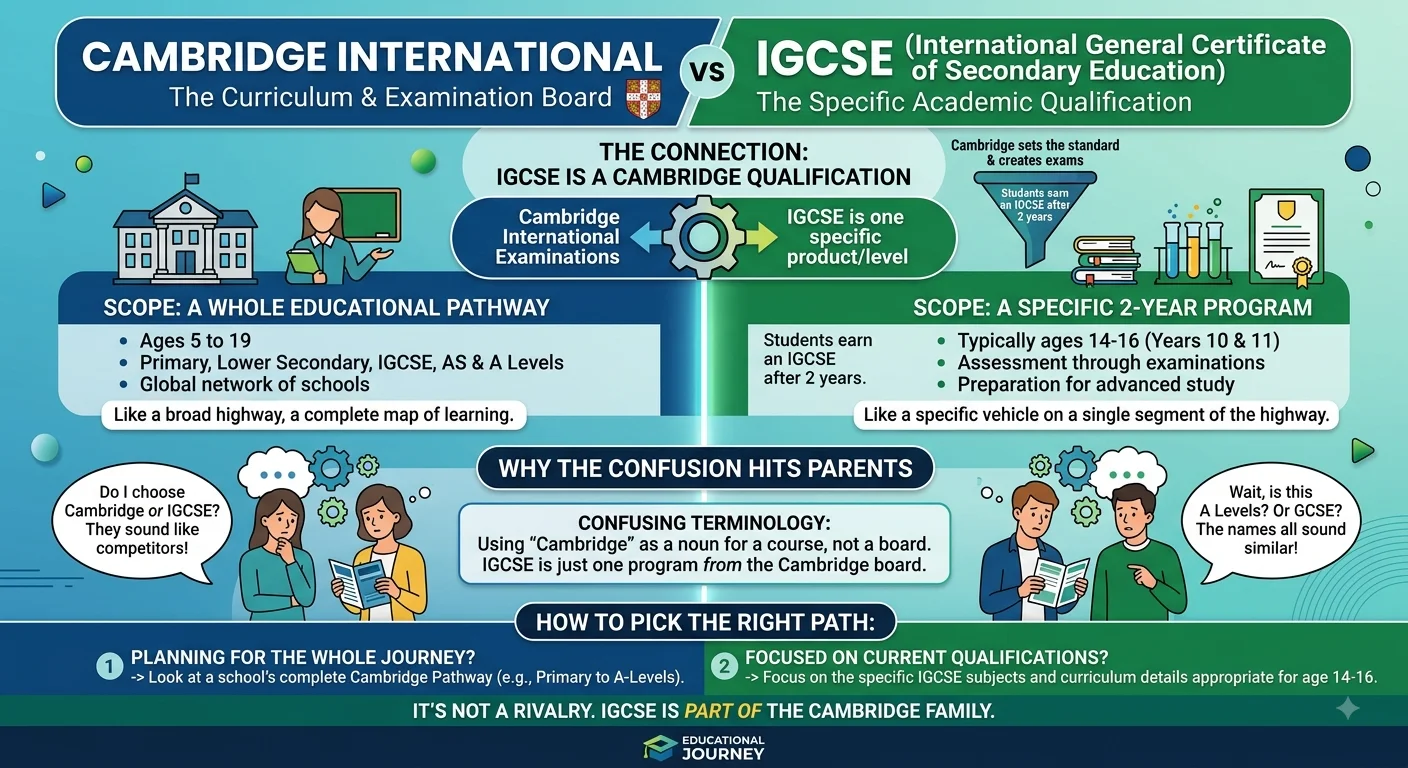
Cambridge vs IGCSE is not really a fight between two rivals. It is a mix-up parents get stuck on because the two names sound like separate systems when they are actually connected. This post breaks down what each one is, why the confusion happens, and how to pick the right path for your child without wasting a year figuring it out.
Parents Face Confusion in Choosing Between Cambridge and IGCSE
If you have started looking into international schooling for your child, you have probably typed “Cambridge vs IGCSE” into Google at least once. And you probably closed ten tabs without a clear answer.
When parents hear terms like Cambridge education, Cambridge International exams, or IGCSE exams, they often feel overwhelmed. Both systems are linked to the University of Cambridge UK through Cambridge Assessment International Education, yet the differences are not always clear.
Schools use the words “Cambridge” and “IGCSE” like they are two different curriculum options. Parents in Pakistan, the UAE, Canada, and Europe hear it in admission offices, in WhatsApp groups, and in Facebook parent forums. Someone says, “We do Cambridge.” Someone else says, “We do IGCSE.” It sounds like a choice. It is not, at least not in the way most people think.

Cambridge International Education offers a pathway from primary to advanced levels, including Cambridge Lower Secondary, IGCSE, and A Levels.
IGCSE stands for International General Certificate of Secondary Education. It is taken by students aged 14–16 and is recognized in over 190 countries according to Cambridge Assessment International Education.
Parents struggle because both systems promise global recognition, but the exam style, grading, and preparation requirements differ.
Cambridge is offered by over 5,000 schools in more than 140 countries, and IGCSE is one of the qualifications sitting inside that Cambridge system, according to Cambridge International’s own facts and figures report. So when a parent asks “should I choose Cambridge or IGCSE,” they are often comparing an umbrella to one thing under that umbrella. That mix-up is the actual problem, and it costs families real time and real money when it goes unresolved.
It adds another layer of confusion: Cambridge International (the exam board, formally called Cambridge Assessment International Education) is not the same thing as the University of Cambridge in the UK. They are historically connected, but they operate separately today. Parents searching for “Cambridge University” school programs often land on pages about the exam board instead, which adds one more reason people give up halfway through their research.
Why the Wrong Choice Can Hurt Your Child’s Future
Choosing the wrong curriculum can lead to:
- Mismatch with child’s learning style:Cambridge exams often emphasize application-based questions, while some IGCSE boards (like Edexcel) focus more on structured problem-solving. According to Sir Faraz Hassan, Cambridge IGCSE Mathematics requires both calculator and non-calculator papers, while Edexcel allows calculators in all papers.
- University pathway confusion: Both Cambridge and IGCSE are accepted by UK universities, but the grading scales differ. Cambridge uses A*–G, while Edexcel IGCSE uses 9–1. Parents may misinterpret results when comparing.
- Cost and resource differences: A case study by Taqwa Tutors shows that Cambridge International exams often require higher resource costs (specialist tutors, textbooks, past papers), while local O Level systems may be cheaper.
- Performance prediction issues: Research by Cambridge Assessment found strong correlations between Cambridge Lower Secondary Checkpoint scores and later IGCSE results. This means students who start with Cambridge earlier often perform better in IGCSE exams.
Parents who ignore these differences risk placing their child in a system that doesn’t match their strengths or long-term goals.

Choosing a curriculum path is not a small decision you can casually reverse in Grade 8. It affects:
- Which exams your child sits at 14 to 16 years old
- Which subjects are available to them
- Whether their qualification transfers smoothly if you move country
- Whether local and international universities recognize their final results
Get this wrong, and the fallout is not abstract. It shows up as a Grade 9 student switching schools mid-year because the new curriculum does not line up with the old one. It shows up as a family paying for extra tuition to cover gaps between two exam boards. It shows up as a 16-year-old who studied hard, but whose transcript confuses a university admissions officer because the subject codes look unfamiliar.
A Real Example of What’s at Stake
Look at the scale of this system to understand why the details matter. In 2024, 631,248 students worldwide received their Cambridge IGCSE, O Level, and International AS and A Level results, representing 5,261 schools across 140 countries, according to Relocate Magazine’s coverage of Cambridge’s results data. That is not a small, niche system. It is one of the most widely used international qualification networks in the world, which means competition among students is high and consistency in your child’s academic record matters.

In the same reporting year, entries from state schools in the US grew by 15 percent and entries in China rose by 11 percent, according to the same Relocate Magazine report. That tells you something important: this is not a system only for elite international schools anymore. Regular schools around the world are adopting it because universities recognize it. Over 2,670 universities in 99 countries formally recognize Cambridge qualifications, including every UK university and more than 1,070 universities in the US, according to Cambridge International’s facts and figures report.
Now bring this closer to home. In India alone, more than 700 schools offered Cambridge International programs, including IGCSE, as of May 2025, and that number has been climbing steadily, according to Sixth Element School’s breakdown of Cambridge adoption. Families across South Asia are making this same decision you are making right now, and the numbers show that most of them are choosing this path deliberately, not by accident.
This is the part parents miss. If your child is one of hundreds of thousands sitting these exams every year, being unclear about which qualification does what is not a minor gap. It puts your child at a disadvantage compared to families who understood the system from day one.
Understand How the Two Actually Fit Together
Let’s clear this up in plain terms.
What Cambridge International Actually Is
Cambridge International is the exam board and curriculum provider. Think of it as the parent structure. It covers a full pathway:

Cambridge Primary (ages 5 to 11) Cambridge Lower Secondary (ages 11 to 14) Cambridge Upper Secondary, which includes IGCSE and O Level (ages 14 to 16) Cambridge Advanced, which includes AS and A Levels (ages 16 to 19) So “doing Cambridge” simply means your child’s school follows this pathway. It does not tell you which specific stage or qualification they are working toward.
What IGCSE Actually Is
IGCSE stands for International General Certificate of Secondary Education. It is the qualification your child sits at the end of the Upper Secondary stage, usually around Grade 9 to 10. It was founded in 1988 to give students an internationally recognized alternative to country-specific exams, and it is now offered in nearly 6,000 schools across more than 150 countries, according to VACE Global’s comparison guide.
In short: Cambridge is the full journey. IGCSE is one specific exam your child takes partway through that journey. Asking “Cambridge or IGCSE” is a bit like asking “school or final exam.” One contains the other.
So Where Does the Real Choice Come In?
The real decision parents face is not Cambridge vs IGCSE. It is usually one of these three actual choices:
Cambridge IGCSE vs a national curriculum (like Pakistan’s Federal Board or Matric system):
This is about whether you want an internationally transferable qualification or a locally focused one. If your family may relocate, or if your child may apply to universities outside Pakistan, an internationally recognized qualification like Cambridge IGCSE keeps more doors open.
Cambridge IGCSE vs Edexcel International GCSE:
Both are IGCSE-type qualifications from different exam boards. Cambridge IGCSE is more common in international schools worldwide, while Edexcel International GCSE is popular in UK independent schools, according to LumiExams’ comparison guide. Both use the same A* to G grading scale, and UK universities, including Oxford and Cambridge, treat IGCSE and standard UK GCSE as equivalent for admissions purposes, based on the same LumiExams guide.
IGCSE vs continuing straight to A Levels without it:
IGCSE stage and move students directly into an A Level track. This can work for strong students, but it removes the two-year buildup that IGCSE gives, which many students rely on to strengthen exam technique before tackling A Level content.
Once you know which of these three you are actually deciding between, the fog clears fast.
A Simple Framework to Decide
Instead of getting stuck on curriculum names, walk through these four questions with your child’s school:

Where might your family live in the next five years?
If there is any chance of relocation, prioritize a qualification with strong international recognition. IGCSE and A Levels both travel well across borders.
What subjects does your child need for their target career path?
Cambridge offers over 70 subjects at IGCSE level, according to Cambridge International’s facts and figures report. Check that the school’s specific subject list matches what your child will need for medicine, engineering, business, or whatever path they are leaning toward.
Does the school follow a full Cambridge pathway, or just borrow the IGCSE exam at the end?
Some schools blend a national curriculum with IGCSE only in the final two years. Others follow the full Cambridge Primary through Advanced pathway. Ask directly. This affects how smoothly your child moves between grade levels.

What do past students from this specific school actually do after Grade 10?
Do not just ask about the curriculum in theory. Ask the school for real outcomes: how many students moved on to A Levels, how many switched systems, and where their results landed them. This is where past papers and school-level results data matter more than general curriculum descriptions. Reviewing IGCSE past papers with your child’s current teacher is also a practical way to judge whether the school’s teaching matches the exam’s actual demands, rather than just following a textbook.
| Factor | Cambridge | IGCSE (Edexcel/Other Boards) |
| Exam Style | Application-based, mix of calculator and non-calculator papers | Structured, calculator allowed in all papers |
| Grading | A*–G scale | 9–1 scale (similar to UK GCSE) |
| Recognition | Accepted worldwide, strong link to University of Cambridge UK | Accepted worldwide, identical UCAS weight |
| Cost | Higher resource cost (specialist tutors, Cambridge source materials) | Often lower cost, easier access to local tutors |
| Best Fit | Students aiming for international universities, strong conceptual learners | Students needing structured exam style, familiar with UK GCSE system |
Where This Applies at Home
At Nisar Academy, we get asked about this constantly, mostly from parents managing their child’s education from overseas while trying to keep things rooted in a Pakistani and Islamic home environment. Our answer is always the same: do not choose a label, choose a pathway that fits your child’s next five years, not just their next school year.
The IGCSE stage matters because it is often the first time a child sits a fully internationally benchmarked exam. Getting that foundation right, with proper subject selection and enough practice on past papers, sets up everything that follows in A Levels and university applications.
Final Guidance
Parents should not choose based on prestige alone. Instead:
Review past papers (Cambridge CIES, IGCSE past papers, IGCSE past paper physics).
Consider your child’s learning style (conceptual vs structured).
Factor in budget and tutor availability.
Align with future university goals (Cambridge University England, overseas admissions, or local pathways).

The Bottom Line
Cambridge vs IGCSE is not about which is better overall, but which fits your child’s strengths and future goals. Cambridge International suits students aiming for global universities and conceptual learning, while IGCSE boards like Edexcel may be better for structured learners and cost-conscious families.
Do not let the terminology hold up a decision; your child’s actual results, subject interests, and future goals should be driving instead. Talk to your child’s school directly, ask for their specific IGCSE subject list and past results, and make the choice based on that, not on which word sounds more familiar
In short: Cambridge vs IGCSE is a choice shaped by your child’s learning style, family resources, and long-term academic goals. The right decision comes from matching the curriculum to the student, not the prestige of the name.
Pingback: IGCSE Narrative Writing: The Ultimate Guide & Best Tips (2027 Guide)
Pingback: Proven Narrative Writing Examples That Guarantee Better Grades (2027 Guide)