
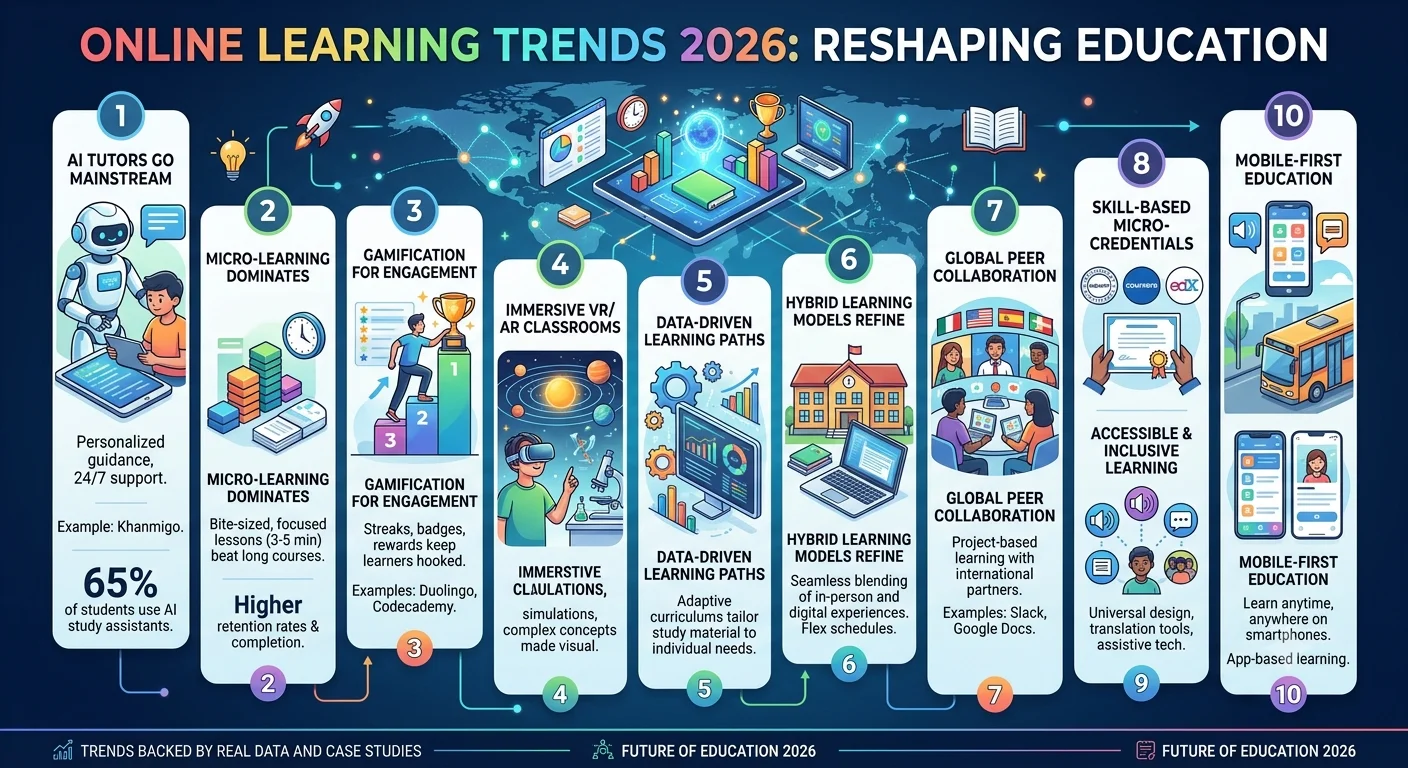
Online Learning Trends 2026 are reshaping how students study and how schools operate. AI tutors are going mainstream, short lessons are beating long courses, and streaks and rewards are keeping learners hooked. Here are 10 trends, backed by real data and case studies, that show where online education is headed next.
Online Learning Is Changing Fast, and Most People Are Behind
Online Learning Trends 2026 are moving fast, and most schools, teachers, and parents are still working with old assumptions about what works.
Online learning is not new anymore. But it is still changing every year. New tools show up. Old platforms lose users. Parents get confused about which online learning platforms for kids actually work. Teachers feel pressure to add AI tools they don’t fully understand. Institutions plan a budget for online courses, but the plan is already outdated by the time it launches.
If you run a school, teach online, or manage your child’s education online courses, you feel this. You picked a platform two years ago. It felt modern then. Now it feels slow. Your competitors added AI tutors. Your students want short video lessons, not hour-long ones. Your online learning centre gets fewer sign-ups than last year, even though enrollment in online learning overall is going up worldwide.
This is the real problem. Online education is growing fast, but most schools, teachers, and parents are working with old assumptions about what works.
What Happens If You Ignore These Trends
Here is what happens when you don’t update your approach to online learning.
You lose students to platforms that use AI to personalize lessons. The AI-in-education market is on a growth path of over 17% a year, expected to top $5 billion by 2033, according to eLearningStats. Parents are choosing programs that adapt to their child, not one-size-fits-all video lessons.
You lose engagement because your lessons are too long. Long-form courses average only 20% to 30% completion, according to eLearning Industry. Learners start a course, get bored, and quit. That is money and effort wasted, whether you are a teacher, a course creator, or a parent paying for classes online.
You lose trust because you can’t show results. Nearly 73% of U.S. students say they want to keep learning online after trying it during the pandemic, according to Demand Sage. But that number only holds if the online classes actually work. If students don’t retain information or don’t finish courses, they go back to physical classrooms or drop out completely.

You lose relevance because your competitors already moved. The global e-learning market passed $320 billion in 2025 and keeps climbing toward $1 trillion by 2032, according to EntrepreneursHQ, citing Global Market Insights. That is not a small niche anymore. It is a crowded market, and slow movers get left behind.
This is not meant to scare you. It’s meant to make the next section useful. Once you understand the size of the shift, the trends below make more sense. For a broader look at where the industry is headed, see our related post on 15 Future Global Trends in E-Learning (2026 and Beyond).
10 Online Learning Trends and Insights for 2026
Here are 10 trends shaping online education right now. Each one comes with data or a real case study, so you can act on it instead of just reading about it.
1. AI Tutors Are Becoming Normal, Not Experimental:
AI tutoring used to be a pilot project. Now it is mainstream in many school districts.

Khan Academy’s AI tutor, Khanmigo, is a clear case study. It launched in March 2023. By the 2024–25 school year, Khanmigo usage grew from about 68,000 students and teachers to more than 700,000, across over 380 school district partners in the U.S., according to EdWeek. By late 2025, more than five million students across 110 countries had used it, reports Edrus. One school district in Northern California said the tool saved teachers around five hours a week on lesson planning and grading support, according to BuildMVPFast. Khan Academy also shares its own findings on Khanmigo’s development on its official blog.
What this means for you:
If you run an online learning centre or manage classes online, an AI tutor or AI-assisted grading tool is no longer a “nice to have.” It is becoming standard, the way a learning management system became standard a decade ago.
2. Microlearning Beats Long Courses
Attention spans are short. Short lessons work better than long ones, and the data backs this up clearly.
Microlearning courses (lessons under 10 minutes) show completion rates around 80%, compared to just 20% to 30% for standard long-form online courses, according to Vouch. One training company, Shift Learning, ran a microlearning program for a North American insurance company. Within six months, completion rates went up 40%, and knowledge retention improved by 30%, as reported by Vouch.
What this means for you:
If your online course learning content is built from long videos, break them into 5 to 10 minute chunks. This applies to adult courses and to online learning programs for kids, where attention spans are even shorter.
3. Gamification Keeps Learners Coming Back
Gamification is not just for children’s apps anymore. It is one of the biggest drivers of learner retention.

Duolingo is the clearest example. As of its 2025 SEC filing, Duolingo had over 52 million daily active users, up 36% year over year, according to SQ Magazine. About 43 million of its daily users had a streak of 7 days or longer, and 15 million had a streak of a full year or more, per the same SEC filing. The company’s own product team credits streaks, in particular, as the biggest single driver of long-term growth, according to StriveCloud.
What this means for you:
Add streaks, badges, or simple progress bars to your learning online classes. You don’t need a big budget. Even a basic point system increases the chance a student will come tomorrow.
4. Subscription Models Are Replacing One-Time Course Sales
Learners are moving away from buying a single course once. They now prefer ongoing access, similar to a Netflix-style plan.
The e-learning subscription market is on track to reach $50 billion, according to Statista data cited by EntrepreneursHQ. This shift matters for anyone selling education online, from single course creators to full academies.
What this means for you:
Consider offering monthly or term-based access instead of one-time payments. This creates steady income and keeps students enrolled longer, since they don’t need to make a new buying decision every time.
5. Mobile Learning Is the Default, Not an Add-On
More learners study on phones than on laptops now. This affects how content should be built.

Mobile learning is one of the fastest-growing parts of the e-learning market, with an annual growth rate near to 15.9% projected from 2026 to 2031, according to Research.com, citing Mordor Intelligence. Around 74% of companies now build mobile access into their training programs from the start, not as an afterthought, reports Vouch.
What this means for you:
Test your online learning platform on a phone screen before you launch it. If a lesson doesn’t work well on mobile, a large part of your audience will struggle with it.
6. Completion Support Matters More Than Course Content Alone
A course by itself does not guarantee learning. Structure and accountability do.
Research cited in Harvard Business Review, compiled by EntrepreneursHQ, found that plain self-paced online courses are completed at only 10% to 15%. But programs that add coaching, check-ins, or accountability structures see completion rates above 70%.
What this means for you:
If you run a learning online program, build in simple accountability steps. A weekly check-in message, a parent update for online learning for kids, or a live Q&A session can multiply your completion rate.
7. Digital Credentials and Certificates Are Gaining Real Value
Employers are starting to treat online certificates as real qualifications, not just extras on a resume.
A Harvard Business Review report, cited by EntrepreneursHQ, found that 40% of employers now recognize digital certificates as valid alternatives to a full degree for certain roles. This is a shift from a few years ago, when online certificates were seen as less credible than a formal degree.
What this means for you:
If you offer online courses learning tracks for adults or teens, make sure students get a shareable, verifiable certificate at the end. This adds real value beyond the lesson content itself. If you’re looking for specific programs to enroll in or recommend, check out our list of 30 Best Online Courses and Learning Websites for 2026.
8. Corporate and Skills-Based Learning Is Growing Fastest
Companies are investing heavily in online training for their employees, and this is pulling the whole market forward.
The corporate e-learning market was valued at $115.74 billion in 2026 and is projected to reach $211.79 billion by 2031, according to Mordor Intelligence data reported by ProProfs Training. IBM reported that companies using online training programs saw 42% higher revenue per employee compare to those that didn’t, per EntrepreneursHQ. AI, data analytics, and cloud computing courses are the fastest-growing categories right now, according to SkillsCouter.
What this means for you:
If you are building an online learning platform for adults, skills-based, job-relevant courses (not just general knowledge) are where the demand is growing fastest.
9. Parents Are Taking a More Active Role in Kids’ Online Learning
Online learning for kids is not just a “set it and forget it” activity anymore. Parents want visibility into what their child is doing.
Virtual school enrollment in the U.S. passed 562,000 students in a recent year, according to Coursmos. Online learning platforms for kids increasingly include parent dashboards, progress reports, and direct messaging with teachers as standard features, not premium add-ons.
What this means for you:
If you manage an online learning centre for children, build regular, simple parent updates into your process. Parents want short, clear reports, not a login they have to check themselves.
10. Regional Growth Is Shifting Toward Asia and the Middle East
Online learning is not just a U.S. or Europe story anymore. Growth is happening fastest in new regions.
Asia Pacific is the fastest-growing region for e-learning, with a compound annual growth rate of around 17.1%, ahead of North America’s 10.3% and Europe’s 14.2%, according to Straits Research data cited by Research.com. China alone is expected to generate around $40 billion in online learning platform revenue, per the same report.
What this means for you:
If your online education programs serve international families (for example, overseas communities in the Middle East, Europe, or Asia), this is a strong and growing audience, not a side market.
Case Study Insights Table
| Trend | Case Study | Impact |
| AI Tutors | EdWeek, Edrus, BuildMVPFast | Khanmigo grew from ~68,000 to 700,000+ users in one school year; 5M+ students in 110 countries by late 2025; saved one district’s teachers ~5 hours a week |
| Microlearning | Vouch | Shift Learning’s insurance client saw completion rates up 40% and retention up 30% in 6 months; microlearning averages 80% completion vs. 20-30% for long courses |
| Gamification | SEC filing, SQ Magazine, StriveCloud | Duolingo: 52M+ daily active users, up 36% YoY; 43M users on a 7-day+ streak, 15M on a 365-day+ streak |
| Subscription Models | Statista via EntrepreneursHQ | E-learning subscription market on track to reach $50 billion |
| Mobile Learning | Research.com, Vouch | Mobile e-learning growing ~15.9% annually (2026-2031); 74% of companies build mobile access in from the start |
| Completion Support | EntrepreneursHQ, citing HBR | Self-paced courses complete at only 10-15%; courses with coaching/accountability reach 70%+ |
| Digital Credentials | EntrepreneursHQ, citing HBR | 40% of employers now accept digital certificates as valid degree alternatives for certain roles |
| Corporate/Skills Learning | ProProfs Training, EntrepreneursHQ, SkillsCouter | Corporate e-learning market: $115.74B (2026) → $211.79B (2031); companies using online training see 42% higher revenue per employee |
| Parent Involvement (Kids) | Coursmos | U.S. virtual school enrollment passed 562,000 students in a recent year |
| Regional Growth | Research.com, citing Straits Research | Asia Pacific e-learning CAGR ~17.1%, vs. 10.3% (North America) and 14.2% (Europe); China projected at ~$40B in platform revenue |
Bringing It Together
Online learning in 2026 is not about picking one trend and ignoring the rest. It is about combining a few of them well. Short lessons. Some form of AI support. A simple reward system. Real accountability. Clear certificates. Regular parent updates if you teach kids.
None of this requires a massive budget. Most of these changes are structural, not expensive. A school, a solo course creator, or a full online learning centre can apply two or three of these trends this month and see a difference in completion and engagement within a few weeks.

The data is consistent across every source: online education keeps growing, but only the programs that adapt to how people actually learn today will keep their students